Saturday, August 15, 2009

“Chocolate Kittens From Mars,” a new short story by Mary A. Turzillo

“Chocolate Kittens From Mars,” a new short story by science fiction writer Mary A. Turzillo, was published in the #107 Summer 2009 issue of Space and Time: The Magazine of Fantasy, Horror, and Science Fiction. Although I haven't read the story, I understand that the plot involves a man named Herschel, his lover Ivy, and a heart-shaped box of bio-engineered kittens from Mars who taste like chocolate when you lick them.

“Chocolate Kittens From Mars” was reviewed by Robert J. Santa
of SFReader, Steve Fahnestalk of Tangent, and Sam Tomaino of SFRevu. Santa, whose review is the most insightful of the three, concludes: “Solid ending, solid writing, this piece is nice for dessert.”

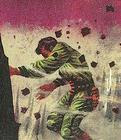
Here's an illustration by artist Alan F. Beck of the chocolate kittens from Mars.

Friday, August 14, 2009

Author Joe Haldeman on 2009 Hugo Awards: “I'm sort of glad I wasn’t up for Marsbound”

SF author Joe Haldeman, who has won two Hugo Awards in the past for best novel of the year, had an interesting reaction to the 2009 Hugo Award for Best Novel, which was recently awarded to The Graveyard Book, by Neil Gaiman, at Anticipation, the 67th World Science Fiction Convention. In the August 11, 2009, entry of his LiveJournal, Haldeman wrote:
As to the Hugos ... congrats to the winners, and I'm sort of glad I wasn't up for Marsbound. I would've hated to have lost to Neil for The Graveyard Book, which I'm sure is good, won the Newbery for children's lit and all. But the Hugo used to be a science fiction award. The Graveyard Book is a fine ghost story.

I can't complain about the award being influenced by personality, since I'm sure I wouldn't have won as many if I just sat here and wrote, rather than going out and exposing myself to the fans. But still. A YA ghost story?
According to a detailed list of nominees for the 2009 Hugo Awards released by The Anticipation Hugo Committee, Joe Haldeman's novel Marsbound (2008) received 28 votes for best novel of the year, putting it at #16 in the rankings, well behind Cory Doctorow's Little Brother (#1, 129 votes), Neal Stephenson's Anathem (#2, 93 votes), and Neil Gaiman's The Graveyard Book (#3, 82 votes).

Watch Buck Rogers battle Tiger Men of Mars in rare 1934 promotional film

Thanks to the UCLA Film Archives, a blog called Matinee At The Bijou, and YouTube, you can watch Buck Rogers in the 25th Century: An Interplanetary Battle with the Tiger Men of Mars, a rare, 8-minute promotional film that premiered at the Chicago World's Fair in 1934 but never made it into movie theaters.

Adapted from the Buck Rogers comic strip and starring John F. Dille, Jr., the son of the businessman who owned the strip, here is a description of Buck Rogers in the 25th Century: An Interplanetary Battle with the Tiger Men of Mars, taken from the Internet Movie Database:

A signal from Buddy Deering on Mars warns Earth that the Tiger Men of Mars and their cruel king have broken their treaty and are attacking. Buck Rogers and Wilma Deering go to rendezvous with the Earth battlefleet before setting off to fight the tigerships. Baldpated genius inventor Dr. Huer uses the ‘cosmic radiotelevision’ to watch the space battle. Which side will be victorious? The tigerships and their paralysis ray? Or our Earth forces, armed with the flash ray and Dr. Huer's new magnetic ray?

According to Matinee At The Bijou, a 35 mm print of the film was discovered by the filmmaker’s granddaughter, donated to UCLA, restruck, and posted on the Internet. Apparently, the film was also shown at the July 2006 Pulpcon in Dayton, Ohio, and at the May 2007 Windy City Pulp Convention in Chicago. For more information about the making of the film, read “Oh, Buck! Wasn't that a battle!” on Matinee At The Bijou.

Thursday, August 13, 2009

Plaintiff in "Big Brother" lawsuit over Kindle e-reader deletes references to legal dispute

Antoine J. Bruguier, a twenty-something software engineer in California and one of the plaintiffs in a class-action lawsuit filed against Amazon over the alleged “Big Brother” feature in its Kindle e-reader, has deleted from his website references to his involvement in the dispute.

As I detailed in a recent post, “Does Kindle encode evil financial signals in brain, turning staid readers into economic vampires?”, Bruguier announced on his website that if his side wins the class-action lawsuit filed against Amazon and he receives any money, “I will donate it to my local library and I kindly suggest other plaintiffs of the class do something similar. I love the Kindle's technical aspect and I wish for its legal aspect also to be attractive.”

But now, Bruguier has deleted those lines and all other references to the lawsuit from his website. Hey, Big Brother!

One-man play in NYC explores insanity on Mars

“Mars: Population 1,” a one-man science fiction play written, directed and performed by James Allerdyce, has a short run at The Players Loft in New York City, from Saturday, August 15 through Saturday, August 29. With a runtime of only 45 minutes, “enough to take you to Mars and back,” here’s the promotional piece for the play:

Utter isolation. Limitless exploration. As he runs out of air, the
first man to land on Mars comes fact to face with his own sanity, humanity, and space-madness, in this innovative sci-fi experience that will awe your imagination.


“Mars: Population 1” is part of the 13th annual New York International Fringe Festival, which starts tomorrow.

Birdwatching From Mars, a forthcoming dark comic book series written by Barry Napier

Thanks to the generosity of Barry Napier, a dark speculative fiction author who writes stories he wouldn’t want his grandmother to read, you can get a look inside Birdwatching From Mars, a forthcoming comic book series written by Napier and illustrated by a team of artists. Here’s a working synopsis of Birdwatching From Mars, taken directly from Napier’s blog, Ghosts in (Parentheses):

It’s been six years since the asteroid struck Earth. It seemed to have come out of nowhere and by the time the scrambling defenses of the world even noticed it, there was nothing they could do. This seemed odd, seeing as how the asteroid was roughly the size of California.

In the panic of the world, each nation handled things their own way. In America, a lottery was held; 3,000 people were randomly selected to live in government operated military bunkers–one beneath Utah and one beneath Virginia. These people survived the impact and, while still alive, are left to live their lives confined to these underground hideaways.

Over their heads, a few scattered survivors roam the landscape. They are beaten, starving, half-mad. A great deal of those that survived the impact became infected with... something... something that has turned them into ravenous monsters that hunt the uninfected. And beyond this horror there is something else; a new creature walks the Earth, beasts that were not part of Earth prior to the impact. The survivors have no idea what to think of these creatures or of the infected humans, but the leaders in the underground compounds are beginning to piece things together.

And they have started to look skyward, towards the heavens, towards our red neighboring planet. Mars, it seems, shares a very similar history with Earth. It is also a planet full of mystery and horrors that astronomers never discovered.

It’s a shame that the secret operation to transport the world’s elite population to a secret base on Mars was not privy to that information. Because as the survivors of Earth fight their own battles, there is a very bloody situation developing on Mars... one that will forever link the two planets in a gruesome inescapable history.


Although the release date is a bit fuzzy, Napier says that Issue #1 is 22 pages long. Stay tuned for more info or follow developments yourself on the Birdwatching from Mars blog!

Pictured: Part of a page from Birdwatching from Mars. Script by Barry Napier. Inks by Keith Draws. Colours by Ryan Burt.

Wednesday, August 12, 2009

SF Signal’s review of Ian McDonald’s 1988 novel Desolation Road

John DeNardo of SF Signal has written a refreshing review of Desolation Road (1988), a novel by British author Ian McDonald that was recently reprinted by Pyr Books. Set in the growing town of Desolation Road on Mars, here’s a description of the novel:

It all began thirty years ago on Mars, with a greenperson. But by the time it all finished, the town of Desolation Road had experienced every conceivable abnormality from Adam Black's Wonderful Travelling Chautauqua and Educational ‘Stravaganza (complete with its very own captive angel) to the Astounding Tatterdemalion Air Bazaar. Its inhabitants ranged from Dr. Alimantando, the town’s founder and resident genius, to the Babooshka, a barren grandmother who just wants her own child -- grown in a fruit jar; from Rajendra Das, mechanical hobo who has a mystical way with machines to the Gallacelli brothers, identical triplets who fell in love with -- and married -- the same woman.

In providing an insightful critical analysis of McDonald’s novel, DeNardo praises the imaginative cast of characters of Desolation Road but questions the strength of the book’s plot. Expecting a traditional science fiction story, DeNardo got Peyton Place. He concludes: “In the end, Desolation Road felt more like a literary exercise than the cool wondrous story I was hoping for.”

John DeNardo gives Desolation Road a rating of 2 stars out of 5.

"Arm of the Law," a 1950s story by Harry Harrison about a robot named Ned

I just finished reading “Arm of the Law,” a short story written by Harry Harrison. Originally published in the August 1958 issue of Fantastic Universe magazine, "Arm of the Law” is a humorous tale about a robot named Ned, who joins the police force in the sleepy settlement of Nineport on Mars. Here are the opening lines of the story:

It was a big, coffin-shaped plywood box that looked like it weighed a ton. This brawny type just dumped it through the door of the police station and started away. I looked up from the blotter and shouted at the trucker's vanishing back.

"What the hell is that?"

"How should I know?" he said as he swung up into the cab. "I just deliver, I don't X-ray 'em. It came on the morning rocket from earth is all I know." He gunned the truck more than he had to and threw up a billowing cloud of red dust. ...


You can read "Arm of the Law" online or download it for free from either ManyBooks.net or Project Gutenberg.

Thanks to Tinkoo of Variety SF for the tip!

Tuesday, August 11, 2009

Looney Tunes: Crazed killer has Marvin the Martian tattoo

The Tampa Tribune reports that Edward Covington, who is accused of choking, beating, stabbing, dismembering and mutilating his girlfriend and her two young children on Mother’s Day in Lutz, Florida, last year, has several tattoos, including one of Looney Tunes cartoon character Marvin the Martian. According to the newspaper, deputies found Covington, 37, huddled in a closet with blood on his hands, under his fingernails, on the tops and bottoms of his feet and on his back. Charges against Covington include three counts of first-degree murder, three counts of abuse of a dead human body and one count of felony animal cruelty. Prosecutors are seeking the death penalty.

Five places to visit on your Rekal vacation to Mars

The summer is more than half over, but there’s still plenty of time to book an imaginary adventure vacation to Mars through your local Rekal, Incorporated travel agent. With Rekal’s patented extra-factual memory implants and no hidden fees, now is an exciting time to escape your real life and get your ass to Mars! Here are five places
on the Red Planet you should consider visiting during your virtual vacation:

1. Meridian Museum

Located in the western sector of the city of Meridian, just over the longitudinal time line, the Meridian Museum houses many significant carvings and artifacts excavated from aboriginal Martian archaeological sites. Gallery Three has beautiful bas-reliefs depicting incredible and bizarre animals fighting each other, as well as the Siren Goddess, a priceless lump of sandstone discovered in the Mares Sirenium by the Third Expedition, A.D. 2012 (A.M. 23). Eight or nine inches high, with slightly oriental features, elongated earlobes, hair curled in tight ringlets close to the scalp, lips half parted in an expression of pleasure or surprise, this head of a young human woman has baffled archeologists and scientists for years. As the tour guide points out, the aboriginal Martians never came near to space flight and their civilization died before humans existed on Earth!

2. New Plymouth

New Plymouth, situated in the northern hemisphere, grew from the small base that developed around the landing site of the Beagle, the first spacecraft to carry humans to the surface of Mars. The old spacecraft is on display in Founders Square, just behind a bronze statue of Dr. Rebecca Sherman, who discovered Martian prebacteria shortly after the Beagle landed in 2011. New Plymouth Cemetery is also worth a visit, for it has several “statues” of unfortunate prospectors and other travelers who got caught out in the frightfully cold Martian air and froze to death into rock-hard ice sculptures.

3. Carrion Caves

These fabled caves at the northern pole consist of a series of twenty-seven connecting subterranean chambers, carved out by running water in the distant past. According to the ancient chronicles of the first historians of Barsoom, the Carrion Caves were discovered by the yellow men as they retreated from the ravages of the green hordes that overran the planet as the drying up of the great oceans drove the dominant races from their strongholds. A mighty battle was fought near the caves, in which the yellow men were victorious. Legend says they piled the bodies of the dead, both yellow and green, in the subterranean chambers so that the stench might deter their enemies. Hence, the distinct smell of the Carrion Caves.

4. Tomb of Rhiannon

The tomb of the legendary Martian god Rhiannon, the Cursed One, is located in the time-worn hills that loom behind Jekkara, one of the Low Canal towns and ancient stronghold of the Sea Kings. Rhiannon was a rebellious human-superhuman hero-god, whose sinful pride caused some mysterious catastrophe and got him locked in a hidden tomb. More than a million years ago! The Interplanetary Society of Archaeologists considers the tomb of Rhiannon to be the oldest relic on Mars.

5. Sloths coffeehouse

A canyon-wall coffeehouse halfway up Strata City, Sloths is most noted for the breathtaking view and the squirrel-suited cliff jumpers that slam by the windows on their way down to the floor of Valles Marineris, the deepest canyon on Mars. A word of caution to those who think the jumping looks like fun. If you don’t have a reasonably intuitive grasp of the Navier-Stokes equations and a few basic aerodynamic principles, there is a good chance you will kill yourself. Jumpers reach terminal velocities of one sixth of a kilometer per second, and they don’t wear parachutes or rocket harnesses!

Suggested readings:

“Crime on Mars” (1960), by Arthur C. Clarke

How to Live on Mars: A Trusty Guidebook to Surviving and Thriving
on the Red Planet
(2008), by Robert Zubrin

The Warlord of Mars (1919), by Edgar Rice Burroughs

The Sword of Rhiannon (1953), by Leigh Brackett

“The Real Story” (2002), by Alastair Reynolds

Pictured: Rekall advertisement

Demo for forthcoming animated film The Lost Hieroglyph: a Brackett & Burroughs Adventure

Check out this beautiful five-minute demo of The Lost Hieroglyph: a Brackett & Burroughs Adventure, a forthcoming stop-motion animated film, which debuted at the recent Comic-Con 2009 in San Diego. A project of independent filmmaker Steve Weintz of Big Sur,
the film is a retro sci-fi screwball adventure in which “Rocket” Ray Brackett and Catherine Louise "Ceel" Burroughs, his wife, journey to Mars to find a missing relative and a lost book. In
the process, they foil a plot to destroy the Martians and enslave Earth. Here’s a description of the five-minute demo, taken directly from Weintz’s website:

The archaeologist Dr. Michael Brackett runs out of fuel near a ruined temple in the dead sea-bottom of Mars. Seeking cover from pursuit, he hikes over to its statues, and is studying one when he is shot and falls off the platform. A Martian warrior, who has been chasing him across the dead sea-bottom, holsters her pistols and draws her swords for the Close Combat. Dr. Brackett attempts to rise and fend off the warrior, but as she raises her blades we fade to black...

The Lost Hieroglyph: a Brackett & Burroughs Adventure is full of literary, visual, and historical references to science fiction. Read
the biographies of the full cast of characters: Ray Brackett, Ceel Burroughs, Fritz Leiber, Mrs. Margaux Leiber, Dr. Michael Brackett, and the Martian Warrior!

Pictured: Promotional poster for The Lost Hieroglyph: a Brackett & Burroughs Adventure. Adventure never looked this good!

Monday, August 10, 2009

Author Scott Westerfeld inspired by Fenton Ash’s 1909 novel A Trip to Mars

A few weeks ago, Publishers Weekly ran an interesting profile of award-winning science fiction author Scott Westerfeld, who is perhaps best known for Uglies, his Young Adult series of books. Westerfeld’s forthcoming novel Leviathan (Simon & Shuster, October 2009), which “imagines a WWI fought with hybrid creatures, living products of Charles Darwin's 19th-century discoveries about DNA and bioengineering,” is packed with steampunk, airships, and military history.

Westerfeld’s inspiration for Leviathan, which will contain 50 interior illustrations, began with A Trip to Mars, a 1909 science fiction novel written by Fenton Ash, a pseudonym of Francis Henry Atkins, Sr.,
that follows two British juveniles on a voyage to Mars, where they encounter the planet’s winged inhabitants. A Trip to Mars featured full-color illustrated plates but no female characters. “There was a King of Mars, and a Prince of Mars, but typical of books written in that era, no Princess of Mars,” Westerfeld told Publishers Weekly.
“I wanted a story that had the same look and feel of something like Boys' Own Adventures, but would appeal to girls, too.”

Scott Westerfeld is married to YA novelist Justine Larbalestier.

Pictured: A Trip to Mars (1909), by Fenton Ash.

“Mars Bound,” a new fantasy story by K.J. Gould about an elf on the Red Planet

“Mars Bound,” a new fantasy short story written by K.J. Gould in which an elf hopes to become the first of her race to land on the Red Planet, was published in Ages of Wonder (March 2009), a Canadian anthology of nineteen stories of myth and magic.

According to the Fantasy Book Critic, "Mars Bound” “follows an unconventional and out of the ordinary storyline. The author explores a credible future where elves live among people and manage to get on the planet Mars because of the ambition of such a being. This is a good opportunity for the author to analyze the roots of magic that the elves possessed and how they are using of it with so much grace. A story which proves that the imagination beats the stereotype and that there are still writers that can write original elves stories.” The Fantasy Book Critic’s conclusion: “The premise is interesting but the author's style did not quite work for me.”

Pictured: The anthology Age of Wonder (2009).

Augustine Committee to scientist Robert Zubrin re case for Mars: “We’ll read your book”

In what is the latest sign that the Obama adminstration is cool to the idea of NASA bypassing the moon for a human expedition direct to Mars, the presidential Review of U.S. Human Space Flight Plans Committee -- known as the Augustine Committee after its head, Norman Augustine
-- was less than receptive to testimony from Robert Zubrin, scientist, author, and president of the Mars Society, at a hearing regarding the future of NASA. According to an article in the Houston Chronicle:
But the panel, led by retired aerospace executive Norman Augustine, appeared to brush off the Mars proposal and focused instead on generating a far more modest road map to send to Obama by Aug. 31.

“Your enthusiasm is certainly not lacking,” Augustine told Zubrin, author of The Case for Mars. “We appreciate that. We'll read your book.”

Neither Augustine nor any member of the panel questioned Zubrin after a fast-moving briefing where the witness belittled rival proposals to return astronauts to the moon for the first time since 1972. [...]

But Augustine made it clear that ignoring costs to quickly reach Mars would not be an option presented to the president.

“There's no sense proposing things that are dead on arrival,” said Augustine, a former head of Lockheed Martin and a veteran of past presidential study commissions.

“If something is plausible, we ought to include it. If it's not, we should move on.”
Dr. Robert Zubrin is the author of the nonfiction book The Case for Mars (1996), the science fiction novel First Landing (2001), and the hybrid book How to Live on Mars: A Trusty Guidebook to Surviving and Thriving on the Red Planet (2008).

Norman Augustine is the author of Augustine’s Laws (6th edition, 1997). Law XXXI: “The optimum committee has no members.”

Sunday, August 9, 2009

Chris Roberson’s alternate history novel The Dragon’s Nine Sons wins 2008 Sidewise Award

Congratulations to author Chris Roberson, whose novel The Dragon’s Nine Sons (Solaris, 2008) won the 2008 Sidewise Award for Best Alternate History Long Form at Anticipation, the 67th World Science Fiction Convention, held this weekend in Montréal.

The first novel in Roberson’s epic The Celestial Empire alternate history series in which China has achieved world domination, The Dragon’s Nine Sons revolves around a military conflict between China and Mexico on and in the neighborhood of a partially terraformed planet called Fire Star (Mars). Taking the title of his novel from an
old Chinese legend, Roberson once compared The Dragon’s Nine Sons to The Dirty Dozen in space.

Roberson was genuinely surprised by winning the Sidewise Award. Read his response: "2008 Sidewise Award, the acceptance speech
that wasn't."


The Dragon’s Nine Sons was reviewed by John DeNardo of SF Signal, Rob Bedford of SFFWorld, Duncan Lawie of Strange Horizons, Stephen Silver of SF Site, Russell Letson of Locus Online, the Fantasy Book Critic, and Don D’Ammassa.

The first three chapters of The Dragon's Nine Sons are posted on BookSpot Central Review.

Thanks to John DeNardo of SF Signal for the Sidewise Award news about The Dragon's Nine Sons.

Art: The clouds of Rocket Summer

I created a word cloud for "Rocket Summer,” a vignette written by Ray Bradbury that comprises the first chapter of his classic The Martian Chronicles (1950). Speaking of the clouds of Rocket Summer, check out “Rocket Days of Summer,” a recent oil painting by award-winning SFF&H artist Bob Eggleton that was inspired by a couple of Robert A. Heinlein's works.