.jpg) A.V. Club (not to be confused with the Italian football club A.S. Roma) recently posted an interesting review of The Alternate Martians (1965), a paperback original penned by Australian science fiction writer A. Bertram Chandler that comprises one-half of an old Ace Double novel. Apparently, The Alternate Martians is “akin to what Alan Moore and Kevin O’Neill pull off with their League of Extraordinary Gentlemen books.”
A.V. Club (not to be confused with the Italian football club A.S. Roma) recently posted an interesting review of The Alternate Martians (1965), a paperback original penned by Australian science fiction writer A. Bertram Chandler that comprises one-half of an old Ace Double novel. Apparently, The Alternate Martians is “akin to what Alan Moore and Kevin O’Neill pull off with their League of Extraordinary Gentlemen books.”
Showing posts with label Ace Double Novels. Show all posts
Showing posts with label Ace Double Novels. Show all posts
Tuesday, August 24, 2010
Review of A. Bertram Chandler’s 1965 novel The Alternate Martians
A.V. Club (not to be confused with the Italian football club A.S. Roma) recently posted an interesting review of The Alternate Martians (1965), a paperback original penned by Australian science fiction writer A. Bertram Chandler that comprises one-half of an old Ace Double novel. Apparently, The Alternate Martians is “akin to what Alan Moore and Kevin O’Neill pull off with their League of Extraordinary Gentlemen books.”


Thursday, July 1, 2010
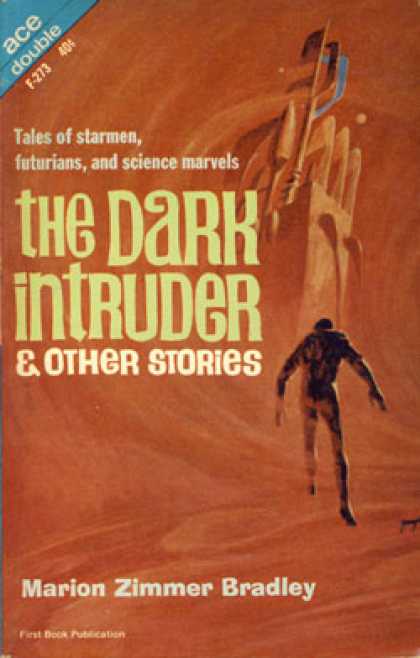
The Dark Intruder & Other Stories written by Marion Zimmer Bradley
.JPG) The Dark Intruder & Other Stories (1964), a collection by Marion Zimmer Bradley
The Dark Intruder & Other Stories (1964), a collection by Marion Zimmer BradleyPictured: Paperback original (New York: Ace Books, 1964), 124 p., #F-273, 40¢. Cover art by Jack Gaughan. An Ace double novel, bound with Bradley’s Falcons of Narabedla. Here’s the blurb from inside the front cover:
Xanadu was a name to chill men's blood -- that is, all but Andrew Slayton's. For him discovering the lost city of Xanadu on the planet Mars was an exciting challenge. His ardor to find this solitary remnant of a Martian civilization long vanished was only the more increased by the knowledge that all those before him in the search had returned insane.
But even his indomitable courage faltered when, one day while out searching alone, a disembodied voice suddenly announced quite clearly, “I am Kamellin.”
"The Dark Intruder," the unforgettable story of Slayton’s quest, is but one of the seven exciting science-fiction adventures included in this new collection.
The short story “The Dark Intruder” was originally published under the title “Measureless to Man” in the December 1962 issue of Amazing Stories magazine. An excerpt from the story is available at Fictionwise.
The collection The Dark Intruder & Other Stories was reviewed by noted SFF critic Rich Horton.
Also of interest: The website of the Marion Zimmer Bradley Literary Works Trust.
Thursday, June 3, 2010
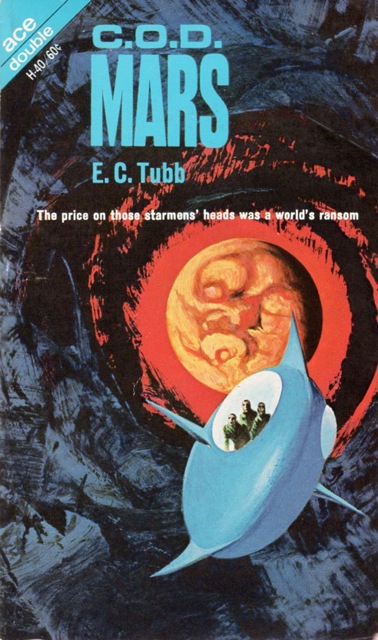
Ace Double Novel: C.O.D. Mars by E. C. Tubb
.JPG) C.O.D. Mars (1968), a novel by E. C. Tubb
C.O.D. Mars (1968), a novel by E. C. TubbPictured: Paperback (New York: Ace Books, 1968), #H-40, 99 p., 60¢. Cover art by Jack Gaughan. An Ace double novel, bound with John Rackham’s Alien Sea. Here's the description from inside the front cover:
“Three explorers returned to Earth after nine long years en route to Proxima Centauri and back. You would have supposed that they would have been greeted as the heroes of the century, feted, honored, rewarded. But Earth was rewarding the trio in a strange and terrible manner -- with permanent exile in orbit, never to touch any planet's surface again.
If Earth wanted that crew isolated so badly, it ought to be worth a lot for someone to learn the reason, because the powers that ruled the world were not talking.
The Scorfu -- the Martian equivalent of a Mafia -- had the idea that the three exiles might prove winning pieces in their endless competition with Earth. And therefore the somewhat unscrupulous but absolutely fearless operative, Slade, could be persuaded that the three from Centauri might mean a million for him -- Cash on Delivery, Mars.”
The Time Machines: the Story of the Science-fiction Pulp Magazines from the Beginning to 1950 (2000), by Michael Ashley, notes that E. C. Tubb was “the most prolific British sf writer throughout the fifties ... a hard-edged writer of sf realism, and few of his stories pull any punches.”
Friday, October 16, 2009
Cover artist Edward Valigursky (1926-2009)
 Commercial illustrator and science fiction and fantasy cover artist Edward Valigursky died September 7th, at the age of 82. An obituary in the September 20th issue of the Pittsburgh Post-Gazette states that Valigursky painted covers for SF&F magazines in the 1950s and 1960s, as well as illustrating book covers for Isaac Asimov, Arthur C. Clarke and Ray Bradbury. Valigursky also did the cover art for several Ace double novels, including The Martian Missile (1960), written by David Grinnell (Donald A. Wollheim).
[via Mike Glyer of the fanzine File 770]
Thursday, July 2, 2009
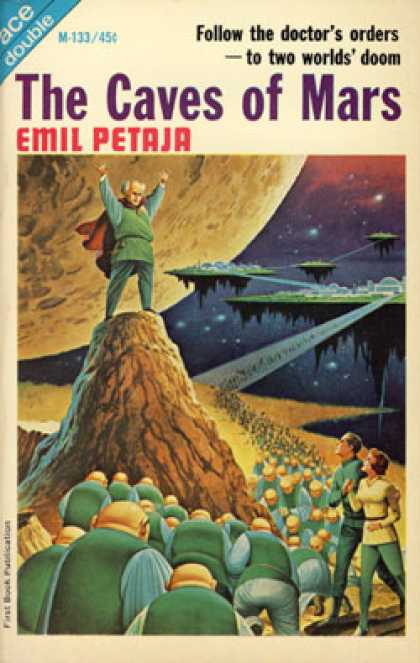
1960s Ace double novel: The Caves of Mars by Emil Petaja
 The Caves of Mars (1965), a novel by Emil Petaja
At left: Paperback original (New York: Ace Books, 1965), 125 p., #M-133, 45¢. Cover by artist Alex Schomburg. An Ace double novel, bound with Space Mercenaries by A. Bertram Chandler.
Here is the blurb from inside the front cover:
Ric Coltor had lost an arm in an interplanetary exploration. For a spaceman at any other time, that would have meant the end of his career. But not with the marvelous Martian Panacea in existence. Extracted from a fungus found only on the Red Planet, it promised mankind perfect health and longer life, for it grew back internal organs, conquered disease, and could even grow back arms. ...
gave its users glowing good health, but it also gave them a fanatical devotion to the man who administered it, Dr. Morton Krill. A devotion that was so all-encompassing that any man who received it could easily become dictator of two planets if he were twisted enough to desire that. Dr. Krill was!
In his The Ultimate Guide to Science Fiction (1990), David Pringle called The Caves of Mars “an ill-written, low-pressure space opera.”
Surprisingly, noted SF&F critic Rich Horton has not reviewed Petaja's The Caves of Mars.
Equally surprising: You can read the first 30 pages of The Caves of Mars online!
Wednesday, January 14, 2009
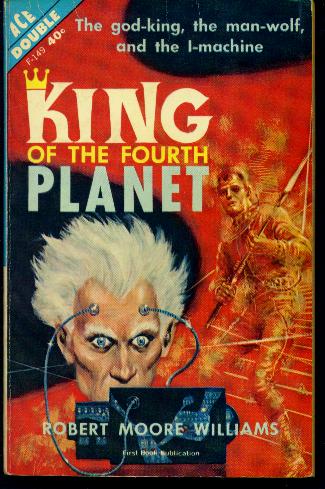
Ace Double Novel: King of the Fourth Planet by Robert Moore Williams
 King of the Fourth Planet (1962), a novel by Robert Moore Williams
At left: Paperback (New York: Ace Books, 1962), 126 p., #F-149, 40¢. Cover art by Ed Emshwiller. An Ace double novel, bound with Charles V. De Vet and Katherine MacLean’s Cosmic Checkmate.
Here’s the blurb from inside the front cover:
“John Rolf fled his own guilt when he abandoned the corruption of Earth for a life of meditation on the many levels of Mars’ mountain, ruled as tradition had it by a king with amazing powers. In this serene climate, Rolf perfected an invention that would explore the human mind -- and thereby unearthed a menace that threatened to annihilate the ancient Martian culture. The discovery confronted Rolf with the crisis of his loyalty and his past. To defy Earth, to save Mars? Yet only the King of the Fourth Planet would have the power to do so -- and everyone believed the king to be a myth.”
Williams' work was reviewed by critic Rich Horton. According to Google Book Search, SF author Lin Carter once called King of the Fourth Planet “a very forgettable novel.” Surprisingly, the book was included in a 2002 science fiction exhibit sponsored by the San Diego State University Library.
Robert Moore Williams is also the author of the collection When Two Worlds Meet: Stories of Men on Mars (1970).
Sunday, December 28, 2008
Ace Double Novel: The Dark Intruder & Other Stories by Marion Zimmer Bradley
 The Dark Intruder & Other Stories (1964), a collection by Marion Zimmer Bradley
At left: Paperback (New York: Ace Books, 1964), 124 p., #F-273, 40¢. Cover art and illustrations by Jack Gaughan. An Ace double novel, bound with Bradley’s Falcons of Narabedla.
Here’s the blurb from inside the front cover:
"Xanadu was a name to chill men's blood -- that is, all but Andrew Slayton's. For him discovering the lost city of Xanadu on the planet Mars was an exciting challenge. His ardor to find this solitary remnant of a Martian civilization long vanished was only the more increased by the knowledge that all those before him in the search had returned insane. But even his indomitable courage faltered when, one day while out searching alone, a disembodied voice suddenly announced quite clearly, “I am Kamellin.” The Dark Intruder, the unforgettable story of Slayton’s quest, is but one of
the seven exciting science-fiction adventures included in this new collection.”
The short story “The Dark Intruder” was originally published under the title “Measureless to Man” in the December 1962 issue of Amazing Stories magazine. An excerpt from the story is available
at Fictionwise. The collection The Dark Intruder & Other Stories was reviewed by SFF critic Rich Horton.
Also of interest: the website of the Marion Zimmer Bradley Literary Works Trust.
Wednesday, December 17, 2008
Bring back the cast of SF characters
 When the books about the Ponzi scheme perpetrated by financier Bernard Madoff are written, one of them
will probably have a “Cast of Characters” printed somewhere between the front cover and the first chapter. Essentially, a cast of characters is a handy
“cheat sheet” that helps the reader keep the characters straight. This feature appears in quite a few books about business history, including Den of Thieves (1991), by financial journalist James B. Stewart, and, more recently, King of the Club: Richard Grasso and the Survival of the New York Stock Exchange (2007), by Charlie Gasparino of CNBC.
There was a time when science fiction books included a cast of characters, although here it seems to have been primarily for marketing purposes. For example, of the more than 100 Martian science fiction paperback books in my collection, a few have a cast of characters. Interestingly, all of them were published by Ace Books from the mid 1950s to the mid 1960s:
• First on Mars (1956), by Rex Gordon
• The Mars Monopoly (1956, double novel), by Jerry Sohl
• The Martian Missile (1959, double novel), by David Grinnell
• The Secret of Sinharat (1964, double novel), by Leigh Brackett
• The Martian Sphinx (1965), by Keith Woodcott
I don’t know if the practice of including a cast of characters in SF books has ended up on the dust heap of history, as I read only an armful of science fiction novels each year. If so, perhaps Ace Books, or another publishing company, could bring back the cast of SF characters.
Saturday, November 29, 2008
Ace Double Novel: The Secret Martians by Jack Sharkey
 The Secret Martians (1960), a novel by Jack Sharkey
At left: Paperback original (New York: Ace Books, 1960), 132 p., #D-471, 35¢. Cover art by Ed Valigursky). An Ace double novel, bound with John Brunner’s Sanctuary in the Sky. Here’s the blurb from inside the front cover:
"Master spy of the Red Planet. Jery Delvin had a most unusual talent. He could detect the flaws in any scheme almost on sight -- even where they had eluded the best brains in the ad agency where he worked. So when the Chief of World Security told him that he had been selected as the answer to the Solar System’s greatest mystery, Jery assumed that it was because of his mental agility. But when he got to Mars to find out why fifteen boys had vanished from a spaceship in mid-space, he found out that even his quick mind needed time to pierce the maze of out-of-this-world double-dealing. For Jery had become a walking bomb, and when he set himself off, it would be the end of the whole puzzle of The Secret Martians -- with Jery as the first to go!"
You can read the first chapter of The Secret Martians at Fictionwise.
Monday, October 20, 2008
Ace Double Novel: The Alternate Martians by A. Bertram Chandler
 The Alternate Martians, a novel by A. Bertram Chandler (1965)
At left: Paperback original (New York: Ace Books, 1965), 129 p., #M-129, 45¢. Cover art by Jerome Podwil. An Ace double novel, bound with Chandler’s Empress of Outer Space. Here’s the blurb from inside the front cover:
When Mariner IV radioed back the vision of Mars as a planet pocked with craters and unlikely to harbor life of any advanced sort, some newspapers wondered how science-fiction writers would take this. But, characteristic of their limitless imaginations, they always come up with an answer.
A. Bertram Chandler presents a particularly challenging response. If Mars is indeed barren, what are we to say of the wonderfully lifelike Mars worlds of H. G. Wells, Edgar Rice Burroughs, Otis Adelbert Kline, and so many others. They are too real to be lost! They must exist somewhere! And so Chandler sends his space expedition to that barren and lifeless Mars to find The Alternate Martians.
It's a science-fiction adventure, packed with action, and filled with some unexpected Red Planet surprises!
Blue Tyson, in summarizing the novel, noted: “Here, apparently a sequel to The Coils of Time of sorts, the idea is that in another coil, the Mars of Brackett or Burroughs or Bradbury might exist in some form, as it is just another time being remembered incorrectly by those writers. With some modification to a ship and time machinery, they manage to investigate. The only problem is they do get somewhere Barsoom-like, complete with a Carter, Tarkas, and a Thoris analogue, but they are enslaved by H. G. Wells Martians!"
In a review of The Alternate Martians, Rich Horton concluded: “As I said, loopy stuff. But in its limited way, kind of fun. Chandler never cared a whit, as far as I can tell, for stuff making sense, or for consistency, or, well, for anything but the next colorful incident. I find that exasperating, on the whole -- others may not care as much.”
Friday, August 22, 2008
Ace Double Novel: C.O.D. Mars by E. C. Tubb
 C.O.D. Mars, a novel by E. C. Tubb (1968)
At left: Paperback original (New York: Ace Books, 1968), #H-40, 99 p., 60¢. Cover art by Jack Gaughan. An Ace double novel, bound with John Rackham’s Alien Sea. Description from inside the front cover:
“Three explorers returned to Earth after nine long years en route to Proxima Centauri and back. You would have supposed that they would have been greeted as the heroes of the century, feted, honored, rewarded. But Earth was rewarding the trio in a strange and terrible manner -- with permanent exile in orbit, never to touch any planet's surface again.
If Earth wanted that crew isolated so badly, it ought to be worth a lot for someone to learn the reason, because the powers that ruled the world were not talking.
The Scorfu -- the Martian equivalent of a Mafia -- had the idea that the three exiles might prove winning pieces in their endless competition with Earth. And therefore the somewhat unscrupulous but absolutely fearless operative, Slade, could be persuaded that the three from Centauri might mean a million for him -- Cash on Delivery, Mars.”
Best known for his Dumarest saga spanning more than 30 volumes, Tubb also wrote several novels based on Space: 1999, the popular science fiction television series of the 1970s.
Michael Ashley, in his The Time Machines: the Story of the Science-fiction Pulp Magazines from the Beginning to 1950 (2000), notes that E. C. Tubb was “the most prolific British sf writer throughout the fifties ... a hard-edged writer of sf realism, and few of his stories pull any punches.”
Thursday, August 14, 2008
Leigh Brackett’s “Black Amazon of Mars” (1951)
 In the afterglow of last winter's Paizo Publishing reprint of The Secret of Sinharat / People of the Talisman, Leigh Brackett's classic 1964 Ace double novel, it’s worth recalling that the latter work is an expansion of an early Brackett novella, “Black Amazon of Mars.”
 First published in Planet Stories in March 1951 and featured on the magazine’s cover, "Black Amazon of Mars" received immediate praise from aspiring science fiction writer Lin Carter, whose letter to the magazine's editor, Jerome Bixby, was published a few months later:
Dear Bix:More than forty years later, the original “Black Amazon of Mars” novella was republished in Stark and the Star Kings (2005), a collection of material by Brackett and Edmond Hamilton, her husband. Interestingly, this collection was reviewed by writer and critic John Clute of SciFi.com. Clute's review prompted a letter to the editor by opposing critic Rich Horton regarding the expansion of "Black Amazon of Mars," which in turn triggered a hilarious response and (Ace) “double thanks” from Clute.
For some reason or another, it seems to be a long time between letters. ... Well, on to the meat of the mag, yclept Black Amazon of Mars, or Stark Rides Again! This was a good, rousing bradswords-and-atom-blaster sort of science-fantasy, in the reliable Planet style. This sort of yarn has been appearing in PS ever since Vassals of the Master World, Black Friar of the Flame, and Red Witch of Mercury, and will undoubtedly keep right on appearing in PS as long as that magazine continues to grace the newsstands. Not that I have anything against this sort of story, but after seeing it so often it becomes tiresome. The story is always the same; hero is bronzed Earthman, heroine is proud Martian princess (or proud Venusian sorceress, or proud Saturnian warrior-queen, etc. cetera), villain who is a ruthless and ambitious fellow Martian or Venusian or Saturnian, who resents the Earthman, having a crush on said proud MP (or PVS, or PSWQ etc.). Repetition does not endear this sort of thing, it just becomes silly.
Now, the only thing that saves Black Amazon from being dull, boring and silly, is that it was written by Leigh Brackett, a talented and imaginative authoress. She took this weary old plot, that would have been limp, uninspired and unreadable hack in the hands of an Erik Fennel or an Emmett McDowell, and turned it into poetry. "The great tower of stone rose up monstrous to the sky. It was whole and there were pallid lights within that stirred and flickered, and it was crowned with a shimmering darkness." She knows the secret of fusing poignant emotion, rich description, convincing action, and above all, a tremendous sense of atmosphere and lavish, excellent use of the English language, to her bare plot and turning it into something damn readable, Black Amazon was a good story, colorful, poetic, and exciting. Let’s have more from Brackett. ...
Sincerely,
Lin Carter, the Sage of St. Pete
The One, the Only, the Original Sage!
Pictured above: Brackett’s “Black Amazon of Mars,” featured on the cover of Planet Stories (Vol. 4, No. 11, March 1951). Art by Allen Anderson.
Thursday, January 3, 2008
Eric John Stark, Martian Adventurer
 Paizo Publishing’s reprint of The Secret of Sinharat, by Leigh Brackett (1964), starring Martian adventurer Eric John Stark, with an introduction by Michael Moorcock, has been released. The title seems a bit misleading, as the book also contains a reprint of People of the Talisman (1964), another Brackett novel featuring Stark.
Here's a description of the new Paizo reprint: “Enter Eric John Stark, adventurer, rebel, wildman. Raised on the sun-soaked, savage world of Mercury, Stark lives among the people of the civilized solar system, but his veneer of calm masks a warrior’s spirit. In the murderous Martian Drylands the greatest criminals in the galaxy hatch a conspiracy of red revolution. Stark’s involvement leads to the forgotten ruins of the Martian Low Canals, an unlikely romance, and a secret so potent it could shake the Red Planet to its core. In a special bonus novel, People of the Talisman, Stark ventures to the treacherous polar icecap of Mars to return a stolen talisman to an oppressed people. The Secret of Sinharat and People of the Talisman make an excellent introduction to the work of Leigh Brackett, a pillar of science fantasy and one of the greatest writers to work in the genre."
The bundling of these two novels is not a new development, as they comprise “Book One” and “Book Two” of Brackett’s single-volume Eric John Stark: Outlaw of Mars (New York: Del Rey/Ballantine Books, 1982).
Also, the two works were bound together as an Ace Double novel (New York: Ace Books, 1964; Series M, #101), in which Edmond Hamilton, Brackett’s husband, wrote an introduction, noting that “her stories about Mars had their inspiration in Edgar Rice Burroughs’ Martian novels.”
Tracing the ink back a bit further, The Secret of Sinharat is an expansion of Brackett’s story “Queen of the Martian Catacombs,” which was published in Planet Stories magazine in 1949. And, People of the Talisman is an expansion of Brackett’s story “Black Amazon of Mars,” which appeared in Planet Stories in 1951. Sci-Fi critic Rich Horton discusses these expansions in his review of the Ace Double novel.
For a larger perspective of Brackett's Red Planet, see Wikipedia's article “Mars in the Fiction of Leigh Brackett.”
Friday, December 21, 2007
The Mars Monopoly by Jerry Sohl (1956)
 The Mars Monopoly, a novel by Jerry Sohl (1956)
At left: Paperback edition (New York: Ace Books, 1956), #D-162, 183 p., 35¢. Cover art by Ed Valigursky. An Ace Double novel, bound with R. De Witt Miller and Anna Hunger’s The Man Who Lived Forever. Here's the blurb from inside the cover:
"A guy's gotta earn a living somewhere – and if it isn't on Earth, it might as well be on Mars. That is if the Syndicate would let you live on the red planet. Bert Schaun found himself washed-up as a round-the-world rocket racer, blacklisted by Thornton McAllister. He tried to make a new life for himself prospecting for uranium in the lonesome vastness of the asteroids. But McAllister’s fury hunted him even to Mars; the issue became a struggle to stay alive against the dangers imposed by McAllister’s interplanetary power. And then Bert found that he was not only fighting for his own survival, but for the survival, too, of a whole race of Martian outcasts. Singlehandedly, he had to combat genocide on the planet Mars!"
Perhaps best known as a script writer for The Twilight Zone, The Outer Limits, and Star Trek, Jerry Sohl also wrote science fiction novels and short stories. One of his more obscure novels, The Mars Monopoly has not been reprinted in the United States. Surprisingly, given Sohl's orbit, the Los Angeles Public Library doesn't own a circulating copy of the book.
Students of Sohl might find some interest in Filet of Sohl: the Classic Scripts and Stories of Jerry Sohl (2003) and the Jerry Sohl papers (1958-1983) at the University of Wyoming’s American Heritage Center.
Jerry Sohl died November 4, 2002, in Thousand Oaks, California. His obituary appeared in the Los Angeles Times and his death was reported by several online sources, including SciFi.com and Locus Online.
Tuesday, December 11, 2007
Cover Art of Leigh Brackett
 The website Of Men & Monsters has an awesome gallery of cover art for author Leigh Brackett, the Queen of Space.
From the February 1940 issue of Astounding Science Fiction, which contains Brackett’s first short story,
“The Martian Quest,” to the 1977 anthology The Best of Leigh Brackett, the gallery displays forty-eight pulp magazine issues and eleven of her books.
Note that Brackett's The Secret of Sinharat (1964) is scheduled to be republished by Paizo Publishing this month as part of its Planet Stories series.
Pictured above: Volume 34, No. 2, June 1949 issue of Thrilling Wonder Stories, featuring cover art by Earle Bergey for Brackett’s novel Sea-Kings of Mars, which was later published as the Ace Double novel The Sword of Rhiannon (1953).
Thursday, October 25, 2007
Ace Double Novels: Bibliographies
 As a follow-up to the posting of October 4, 2007,
“Ace Double novels,” here’s a list of books for those interested in learning more or seeking bibliographies about Ace Double science fiction novels:
• Science Fiction and Fantasy Published by Ace Books (1953-1968), by Dick Spelman (1976, 62 p.)
• The Science Fiction Collector, by J. Grant Thiessen (1980-1981, 3 vols. of fanzines)
• Ace Science-Fiction Double Books, by Roger Robinson (1987, 16 p.)
• Double Your Pleasure: the Ace SF Double, by James A. Corrick, with an Introduction by Donald A. Wollheim (1989, 85 p.)
• Double Futures: an Annotated Bibliography of the Ace Science Fiction Doubles, by Sheldon Jaffery (1996)
• Science Fiction, Fantasy & Horror in the Ace Letter-Series Editions: a Collector’s Notebook, by Harold R. Peters (1996)
Best of success in finding these publications at your local library! Meanwhile, checkout Michael S. Smith's website, The ACE Doubles (and Singles): Image Library.
Thursday, October 4, 2007
Ace Double Novels
 Ace Books was founded in 1953 by A. A. Wyn and is the oldest continuously operating science fiction publisher in the United States. Under the editorialship of Donald A. Wollheim, it published some of the most outstanding writers of the 1950s and 1960s, including Sameul R. Delany, Philip K. Dick, Ursula K. Le Guin, and Robert Silverberg.
Ace was known for creative marketing innovations such as the Ace Double, a paperback book that contained two short novels bound back-to-back. This dos-à-dos format has the two titles bound upside-down with respect to each other, so that there are two front covers and the two texts meet in the middle of the book. Between 1952 and 1973, Ace published about 600 of these dos-à-dos books, covering science fiction as well as other genres.
Ace Double novels that pertain to Mars include:
• The Sword of Rhiannon, by Leigh Brackett (Series D, #36, 1953, cover art by Robert Schulz). Bound with Robert E. Howard’s Conan the Conqueror. Reviewed by Richard Horton.
• The Mars Monopoly, by Jerry Sohl (Series D, #162, 1956, cover art by Ed Valigursky). Bound with R. De Witt Miller and Anna Hunger’s The Man Who Lived Forever.
• The Martian Missile, by David Grinnell (Series D, #465, 1960, cover art by Ed Valigursky), pictured above. Bound with John Brunner’s The Atlantic Abomination. Reviewed by Richard Horton.
• The Secret Martians, by Jack Sharkey (Series D, #471, 1960, cover art by Ed Valigursky). Bound with John Brunner’s Sanctuary in the Sky.
• Rebels of the Red Planet, by Charles L. Fontenay (Series F, #113, 1961, cover art by Ed Emshwiller). Bound with J. T. McIntosh’s 200 Years to Christmas. Reviewed by Richard Horton.
• The Nemesis from Terra, by Leigh Brackett (Series F, #123, 1961, cover art by Ed Emshwiller). Bound with Robert Silverberg’s The Collision Course. Reviewed by Richard Horton.
• People of the Talisman, by Leigh Brackett (Series M, #101, 1964, cover art by Ed Emshwiller). Bound with Brackett’s The Secret of Sinharat. Reviewed by Richard Horton.
• The Secret of Sinhart, by Leigh Brackett (Series M, #101, 1964, cover art by Ed Emshwiller). Bound with Brackett’s People of the Talisman. Reviewed by Richard Horton.
• The Alternate Martians, by A. Bertram Chandler (Series M, #129, 1965, cover art by Jerome Podwil). Bound with Chandler’s Empress of Outer Space. Reviewed by Richard Horton.
• The Caves of Mars, by Emil Petaja (Series M, #133, 1965, cover art by Alex Schomburg). Bound with A. Bertram Chandler’s Space Mercenaries.
• C.O.D. Mars, by E. C. Tubb (Series H, #40, 1968, cover art by Jack Gaughan). Bound with John Rackham’s Alien Sea.
Tuesday, October 2, 2007
The Caves of Mars
 The recent drip of news articles about NASA Mars Odyssey’s discovery of the entrances to seven possible caves on the Red planet is a good opportunity to highlight some science fiction on the same subject, as John DeNardo’s blog, SciFi Scanner, has done.
P. Schuyler Miller’s novelette, “The Cave,” originally appeared in the January 1943 issue of Astounding Science Fiction. It was reprinted in several anthologies, including Jane Hipolito and Willis E. McNelly’s Mars, We Love You: Tales of Mars, Men, and Martians (1971), where the introduction notes: “Miller’s story is beautifully styled and tightly plotted. Moreover, it is one of the most daring Mars tales ever written, for instead of keeping a safe distance and painting the Red Planet in an impressionistic fog, “The Cave” boldly takes a microscopically close focus on Mars and the Martians.”
Perhaps more well know, as DeNardo's blog indicates, is The Caves of Mars, by Emil Petaja (1965), which is half of an Ace Double novel. Here’s a summary: “Ric Coltor had lost an arm in an interplanetary exploration. For a spaceman at any other time, that would have meant the end of his career. But not with the marvelous Martian Panacea in existence. Extracted from a fungus found only on the Red Planet, it promised mankind perfect health and longer life, for it grew back internal organs, conquered disease, and could even grow back arms. ... gave its users glowing good health, but it also gave them a fanatical devotion to the man who administered it, Dr. Morton Krill. A devotion that was so all-encompassing that any man who received it could easily become dictator of two planets if he were twisted enough to desire that. Dr. Krill was!”
Younger readers may find some interest in these two books: Caves of Mars, by NASA physicist Robert S. Wolff (1988), which is volume 1 in his Falcon Gold Space Adventures series; Kipton and the Caves of Mars, by Charles L. Fontenay (1998), which is volume 16 in his The Kipton Chronicles series and is geared towards elementary school students. Fontenay was an accomplished journalist and author, winning several science fiction writing awards. He died earlier this year.
On a different note, the Pink Floyd crowd might enjoy “Caves on Mars,” a non-musical sound track on the recording Sounds from Outer Space (Total Recordings of California, 1992/1995).
Subscribe to:
Posts (Atom)
67.JPG)

 Posts
Posts