Saturday, January 17, 2009

Author Caitlín R. Kiernan considers the science of putting zeppelins on Mars

Eagerly awaiting the return of “Bradbury Weather,” a novella by Caitlín R. Kiernan that was first published in Subterranean magazine issue #2 (2005) and will be reprinted in her forthcoming collection A is for Alien (Subterranean Press, February 2009), I’ve been reading through Kiernan's Low Red Moon journal, which spans the years 2001 to 2005. While she reveals that “the best science-fiction authors recognize that the science must be peripheral to the heart of a story,” Kiernan also believes “a science-fiction writer has an obligation to get the science as ‘right’ as she can at the point in time she's writing a story."
Wednesday, September 01, 2004 ...

I spent several hours researching zeppelins, Martian aerodynamics, hydrazine, nitrogen tetroxide oxidizers, entomopters, and the problems one encounters with propellers and rotors in a thin atmosphere. Turns out, putting zeps on Mars is not as easy as I'd hoped (but nothing ever is). Consider the following:

On Mars, with a sea level equivalent pressure of only 0.7 percent that of Earth, a ten-foot cube of hydrogen would weigh about seven one thousandths as much as on Earth, or about 3.5 thousandths of a pound. But even the Martian atmosphere, at a near vacuum, only weighs in at about a tenth of a pound. So the net difference in weight would be about ninety-six and a half thousandths of a pound. This means that to get a full 73 pounds of lift, we would need about 760 such cubes. Fortunately, Martian gravity is only thirty seven percent that of Earth. So we need even fewer cubes, about 280 cubes. So to carry the same payload on Mars as on Earth we are looking at a design that begins almost 300 times as large as a similar vehicle on Earth [italics mine - CRK]. This sounds extreme, but amounts to a cube of hydrogen on Mars of 67 feet on a side producing our net 27 pounds of lift. Ignoring such pesky add-ons such as structural weight, a dirigible made to lift one person of 200 Earth pounds, or 74 Martian pounds, would need about three Mars-sized cubes for lift. Four people would need a dozen, plus another dozen for payload, and another couple of dozen for fuel and structure. This means a spherical balloon would need to hold almost 50 volumes of a third of a million cubic feet each to be useful. A dirigible of 17 million cubic feet is called for, about triple the size of the Hindenburg.

And I need zeps that can carry dozens of people and a significant cargo payload.
Pictured above: Subterranean #2, depicting a zeppelin on Mars.

Friday, January 16, 2009

Webcomic Marooned: A Space Opera in the Wrong Key places third in global competition

Outer Space Meets Cyberspace: There's Life on the Web for Comic Strip about Mars
By Emily McFarlan
The Courier News (Elgin, IL)
January 11, 2009

WEST DUNDEE -- Try explaining the expression "in a pickle" to a Martian.

That's one of the first problems astronaut Captain John and his not-so-faithful robot companion, Asimov, encountered when they crash-landed on Mars in a Web comic penned by West Dundee resident Tom Dell'Aringa.

Dell'Aringa publishes his comic, "Marooned: A Space Opera in the Wrong Key," every Monday and Thursday online on www.maroonedcomic.com. And last month, the 42-year-old interface designer's science-fiction adventure and humor beat out
84 competitors from across the globe to place third in the annual Webcomic Idol competition sponsored by Bomb Shelter Comics. ...


Read the entire article in The Courier News.

Pictured above: Captain John. Artwork by Tom Dell'Aringa.

PKD: Martians come in clouds

No, not the latest science news from NASA that clouds of methane gas may mean life on Mars, but
an old, often-overlooked short story by Philip K. Dick entitled “Martians Come in Clouds,” which was published in the first issue of Fantastic Universe magazine (June-July 1953).

I haven’t read PKD’s story, but according to Aaron Barlow's book How Much Does Chaos Scare You? Politics, Religion, and Philosophy in the Fiction of Philip K. Dick (2005), “Dick illustrates the basic misunderstanding in almost any culture of the alien outsiders. Here, it is Martians who are brutally attacked and destroyed each time they appear on Earth. All they want, it turns out, is permission to live on the seas, where there are no humans.”

Pictured above: The June-July 1953 issue of Fantastic Universe.

Thursday, January 15, 2009

Poll: Should Oprah’s Book Club read the classic Burroughs novel A Princess of Mars?

I’m taking a poll as to whether Oprah’s Book Club should read A Princess of Mars (1912/1917), the classic novel written by Edgar Rice Burroughs.

The poll is near the top of the right-hand column of this blog, just below the cover art of Ray Bradbury’s The Martian Chronicles.

If you have time, please consider voting, or feel free to leave a comment.

Also, thanks to a post by the blog SF Signal, I just viewed a beautiful gallery of John Carter of Mars artwork put together by The Crotchety Old Fan.

A reading of two 1930s Martian short stories by Stanley G. Weinbaum

Thanks to a recent post by Dave Tackett of the blog QuasarDragon, I just learned about a new audio recording of the Collected Public Domain Works of Stanley G. Weinbaum, which is archived at Librivox. Here’s a description of the recording, provided by the reader, Gregg Margarite:

"Stanley G. Weinbaum is best known for his short story “A Martian Odyssey” which has been influencing Science Fiction since it was first published in 1934. Weinbaum is considered the first writer to contrive an alien who thought as well as a human, but not like a human. "A Martian Odyssey" and its sequel are presented here as well as other Weinbaum gems including 3 stories featuring the egomaniacal physicist Haskel van Manderpootz and his former student, playboy Dixon Wells.”

Pictured above: Cover of A Martian Odyssey and Others (1949), a collection by Stanley G. Weinbaum

Wednesday, January 14, 2009

Building a one-book collection

Apparently, the January 2009 issue of Firsts: The Books Collector’s Magazine has an article about
“Building a One-Book Collection”: “To build a one-book collection, you have to buy more than one book. You have to buy the same book over and over again. And each time you buy it, the copy is different from any of the others you already have.” I’m in the process of building a one-book collection: English-language paperbacks of Ray Bradbury's The Martian Chronicles (1950).

Also, several articles in the back issues of Firsts look interesting:

• October 1991
A Burroughs Collection
Collecting Philip José Farmer

• February 1992
British Fiction Since 1950

• October 1992
Collecting H. G. Wells

• October 1993
Eccentric Classics of Science Fiction

• October 1994
Collecting Philip K. Dick

• October 1997
The Best SF of 1996
Collecting Leigh Brackett

• October 1998
The Best SF of 1997

• October 1999
Kim Stanley Robinson on Mars
Best SF of 1998

• October 2000
Science Fiction, Fantasy & Horror: The Best of 1999

• June 2001
Collecting Ray Bradbury
Ray Bradbury: A Space Legend
A Ray Bradbury Core Collection
A Ray Bradbury Checklist

• October 2001
Beyond the Limits: Time Travel Books
The Best of Science Fiction and Fantasy 2000

• October 2002
Science Fiction, Horror and Fantasy: The Best of 2001

• October 2003
Science Fiction, Fantasy and Horror: The Best of 2002

• October 2004
Collecting Jack Williamson: Master of Wonder
Jack Williamson: A Checklist
Science Fiction, Fantasy & Horror: Best of 2003
Ten Years Ago: Philip K. Dick

• October 2005
Collecting Frederik Pohl
Frederik Pohl: A Checklist of First Editions
Science Fiction Review: 2004

• November 2006
Special Robert A. Heinlein Issue
Introduction & Biography
An Annotated Checklist of the Primary First Editions
The Books: Collecting Robert A. Heinlein

Can hardly wait for an economic stimulus check from the Treasury!

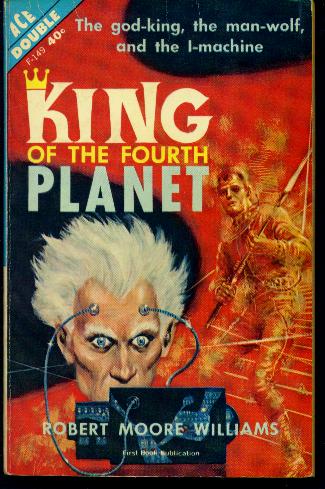
Ace Double Novel: King of the Fourth Planet by Robert Moore Williams

King of the Fourth Planet (1962), a novel by Robert Moore Williams

At left: Paperback (New York: Ace Books, 1962), 126 p., #F-149, 40¢. Cover art by Ed Emshwiller. An Ace double novel, bound with Charles V. De Vet and Katherine MacLean’s Cosmic Checkmate.

Here’s the blurb from inside the front cover:

“John Rolf fled his own guilt when he abandoned the corruption of Earth for a life of meditation on the many levels of Mars’ mountain, ruled as tradition had it by a king with amazing powers. In this serene climate, Rolf perfected an invention that would explore the human mind -- and thereby unearthed a menace that threatened to annihilate the ancient Martian culture. The discovery confronted Rolf with the crisis of his loyalty and his past. To defy Earth, to save Mars? Yet only the King of the Fourth Planet would have the power to do so -- and everyone believed the king to be a myth.”

Williams' work was reviewed by critic Rich Horton. According to Google Book Search, SF author Lin Carter once called King of the Fourth Planet “a very forgettable novel.” Surprisingly, the book was included in a 2002 science fiction exhibit sponsored by the San Diego State University Library.

Robert Moore Williams is also the author of the collection When Two Worlds Meet: Stories of Men on Mars (1970).

Tuesday, January 13, 2009

An interview with John Carter of Mars film director Andrew Stanton

Sci Fi Wire received the latest news on the Disney-Pixar film John Carter of Mars in a January 12th exclusive interview with noted Hollywood film director Andrew Stanton. Stanton was attending the Los Angeles Film Critics Association award ceremony in Century City, California, where he accepted the award for best picture of 2008 for WALL-E.

Stanton confirmed to Sci Fi Wire that the film John Carter of Mars, based on the science fiction books by Edgar Rice Burroughs, will be live-action. "Yeah, I think that's the only way," Stanton said.

To learn more, read Sci Fi Wire's interview with Andrew Stanton.

John Carter of Mars is scheduled to land in theaters in 2012.

Editor Scott Edelman always got Mars stories

Scott Edelman is one of the more interesting and lighthearted characters in science fiction. A former assistant editor at Marvel Comics who later served as editor of Science Fiction Age magazine, Edelman is currently involved in the SciFi Channel’s newly christened Sci Fi Wire entertainment site. In a fascinating September 1997 interview with SF&F writer Jayme Lynn Blaschke that was published in Voices of Vision: Creators of Science Fiction and Fantasy Speak (2005), Edelman recalled how he always received stories about Mars:
Jayme Lynn Blaschke: You mentioned earlier that you, as an editor, are at the mercy of what writers submit. Have you noticed any current trends among the submissions that you receive?

Scott Edelman: It’s funny. The trends that I end up noticing are more political than anything else. I always get Mars stories. The stack of stories on my desk always has Mars in it. There was a period when I was getting O. J. Simpson stories. People wanted to do science fiction stories about O. J. in the future. Things like that happen. I don’t think any of those trends, when they occur, hurt an author in any way. If I buy a great Mars story, I’m not going to turn down another set on Mars just because I’ve already got one in inventory. I don’t think writers necessarily have to steer clear of those trends. It’s what the writer does with the building blocks that matters.
Speaking of building blocks, Scott Edelman constructed one of my favorite short stories: “Mom, the Martians, and Me” (2002), which was published in the anthology Mars Probes (2002).

Monday, January 12, 2009

Heinlein’s softer side: Stranger in a Strange Land

Sam Jordison of The Guardian’s Books Blog has a neat post titled “Robert Heinlein's softer side,” which discusses Stranger in a Strange Land, the winner of the 1961 Hugo Award for Best Novel. Among many interesting points, Jordison mentions that the book has sold more than 5 million copies.
No mention of Charles Manson.

Pictured: Paperback published in the United Kingdom in the 1980s.

NEA report: Fiction reading on the rise for adults

Fiction Reading Increases for Adults
The New York Times
January 11, 2009
By Motoko Rich

After years of bemoaning the decline of a literary culture in the United States, the National Endowment for the Arts says in a report that it now believes a quarter-century of precipitous decline in fiction reading has reversed.

The report, “Reading on the Rise: A New Chapter in American Literacy,” being released Monday, is based on data from “The Survey of Public Participation in the Arts” conducted by the United States Census Bureau in 2008. Among its chief findings is that for the first time since 1982, when the bureau began collecting such data, the proportion of adults 18 and older who said they had read at least one novel, short story, poem or play in the previous 12 months has risen. ...


Read the entire article in The New York Times.

The Martian Crown Jewels,” a Sherlockian Sci-Fi mystery by Poul Anderson

Originally published in the February 1958 issue of Ellery Queen’s Mystery Magazine, “The Martian Crown Jewels,” by Poul Anderson, is a Sherlockian “locked room” science fiction mystery. The plot revolves around the theft of the Martian crown jewels (worth half a billion UN dollars), which are being transported back to Mars from Earth aboard the robot spaceship Jane Brackney. A seven-foot-tall Martian named Syaloch, the most renowned private detective on the Red Planet, is called upon to solve the case. One of the suspects: a technician named John Carter.

Here are the opening lines of the story:

"The signal was picked up when the ship was still a quarter million miles away, and recorded voices summoned the technicians. There was no haste, for the ZX28749, otherwise called the Jane Brackney, was right on schedule; but landing an unmanned spaceship is always a delicate operation. Men and machines prepared to receive her as she came down, but the control crew had the first order of business. ..."

Apparently, the SciFi Channel did an Internet radio adaptation of
The Martian Crown Jewels” for its Seeing Ear Theatre, which aired between 1997 and 2001. To my knowledge, that adaptation, which starred Bronson Pinchot as Syaloch, is not archived on the Internet.

Sunday, January 11, 2009

Review of In the Courts of the Crimson Kings, a novel by S.M. Stirling

Noted SF&F critic Rich Horton has written a lengthy, informal review of S.M. Stirling’s novel In the Courts of the Crimson Kings, which was published by Tor Books in March 2008. To make a long story short, Horton says “I thought the actual final conclusion a bit too much of a deus ex machina, and not quite what I had in mind. Which of course isn't necessarily an author's obligation -- he's writing his book, not mine -- but still! Anyway ... I liked the book, as light entertainment.”

The prologue and first six chapters of In the Courts of the Crimson Kings are posted on Stirling’s website.

This is one of several books I did not have an opportunity to read in 2008. I'm debating whether or not to read it in 2009.

Ruth Nestvold’s short story “Mars: A Traveler’s Guide” makes Preliminary Nebula Awards Ballot

Mars: A Traveler’s Guide,” a short story by Ruth Nestvold which was published in the January 2008 issue of The Magazine of Fantasy & Science Fiction, is on the 2008 Preliminary Nebula Award Ballot.

A clever story told through a rover computer system's responses to queries from a desperate tourist on Mars, the opening lines of “Mars: A Traveler’s Guide” are available at AccessMyLibrary.com.

I just read this wonderful short story and several other readers seem to have enjoyed it:

• “This one is great satire on the drawbacks of computerized help systems.” Sam Tomaino of SFRevu

• “Those who have studied transport disasters will recognize the horrific inevitability of supposed fail-safes not working in a cascade. [...] an object lesson in how to write very short stories.” Colin Harvey of The Fix: Short Fiction Review

• “Had a clever concept, and was short enough that it didn't wear it out, but it almost did. I skipped the infodumps several times, because the story was really between the lines here. A tough thing to manage, but mostly succeeded for me.” Jeremiah Tolbert, writer and contributor to Thaumatrope: The Twittering E-zine

• “Areological technological assistance breakdown. 4 out of 5.”
Blue Tyson, SF megafan

• “An extreme example of the conceit dominating the story. In fact there is no story, only the hint of one glimpsed through the entries accessed on a traveler’s encyclopedia of Mars. A clever bit of work.” Andy Spackman, librarian and aspiring author

• “Nestvold builds an eerie suspense through the limitations of the perspective that's highly effective by the end of the story. A gimmick story, in a sense, but very well-done.” Russ Allbery

• “The perfect parody of everything that is wrong with the computerized phone systems so many companies now use. [...] Now imagine that sort of set up in the wastelands of Mars.” Puss Reboots

To learn more about “Mars: A Traveler’s Guide,” read John Joseph Adams’s comments about his 2007 interview with Ruth Nestvold. According to Nestvold, the seed for her story was "a lecture Michael Swanwick gave at a workshop I once attended that he called How to Win a Hugo."

You can purchase the January 2008 issue of The Magazine of Fantasy & Science Fiction, which contains "Mars: A Traveler's Guide," through Fictionwise.

Saturday, January 10, 2009

Jim Baen Memorial Writing Contest

William Ledbetter announced that the third annual Jim Baen Memorial Writing Contest, sponsored by Baen Books and the National Space Society, is open to submissions through April 1, 2008.

The contest is looking for stories about Moon bases, Mars colonies, orbital habitats, space elevators, asteroid mining, artificial intelligence, nano-technology, realistic spacecraft, heroics, danger, sacrifice, and adventure. The stories will be judged by Hank Davis, Eric Flint, and Mike Resnick. The winner will receive several prizes, including being published in a future issue of Jim Baen's Universe.

For complete details and contest rules, please see the website of William Ledbetter, contest administrator.

Pictured above: Noted science fiction publisher and editor Jim Baen, who died in June 2006.

"Pictures from an Expedition": Barbarella on Mars

With the new John Carter of Mars painting by esteemed artists Boris Vallejo and Julie Bell conjuring up images of Barbarella, it is worth recalling this foreboding passage from “Pictures from an Expedition” (2003), a short story by Alex Irvine in which character Jami "Barbarella" Salter ends up voluntarily marooning herself on Mars:
Some interplanetary sex symbol, she kidded herself. Running to the john every hour. But she was due to make the crew’s daily media dispatch today, and she didn’t want to be drumming her feet on the deck in front of the time-delayed pupils of Earth. The PR hacks at Gates had told her that her dispatches drew ratings fifty percent better than any other crew member’s, and even though she knew this was just a temporary skewing of the audience composition toward young, male, and horny, she had come to feel an odd sort of duty to live up to the standard that had been set for her. So she washed her hair when it was her day to dispatch, and touched a little makeup here and there. Katherine and Debbie kidded her about it, but they knew the score, and Jami thought they were a little grateful that she
was taking the pressure off them.

Said gratitude did not prevent them from nicknaming her Barbarella, though.

All in a day’s work, when the day was spent working for the largest private space venture in the history of humankind. They were seventy-five million kilometers from Earth, and the time delay was now almost four minutes each way. The lag hung between
Argos I and Earth as much as the distance itself. Every time they spoke to friends or family or (more often) media, it felt more and more like they were speaking to the silence and less like any real human beings existed on the other side of the commlink.

She had written those words down in a leather-bound journal she was keeping: speaking to the silence. It had been hard not to write them again. And again.

Barbarella is not coping, she said to herself.
"Pictures from an Expedition" was first published in the September 2003 issue of The Magazine of Fantasy & Science Fiction. It was reprinted in Fourth Planet from the Sun: Tales of Mars from The Magazine of Fantasy & Science Fiction (2005), an anthology edited by Gordon Van Gelder.