Thursday, July 9, 2009

Fans flock to Mars for “Most Awesomely Bad SFF Cover in the World”

Publisher Orbit Books is asking fans for suggestions so it can create an especially bad, but entirely fictional, SFF book cover. If you’re interested, you have a couple of weeks to submit an idea for “the most ridiculously bad high-concept SFF book cover in the universe.” Once Orbit has picked a title, they’ll work out the reading line, the blurbs, and the cover elements. Then, fans will have an opportunity to help Orbit design a cover for the fictional book.

At the moment, 120 fans have submitted fictional book titles or plot concepts. As you can see from the following titles, fans have flocked to Mars and embraced Martians:

• He Left Me on Mars

• The Hobbits Go to Mars

• Invasion of the Massive Mosquito-pods from Mars!

• Mars Needs Fairies!

• Mars on $5 a Day

• Mars or Bust

• Martian in the Mirror

• Martian Sex Trap

• Martian Under the Doormat

• Martians are from Mars, Humans are from Earth: A Practical Guide for Improving Communication and Getting What You Want

• Motherf*ckers from Mars

• Planet of the Martian Ladies

• Revolt of the Martian Marmots, #6 in The Revolting series

• Speed-dating on Mars

• Tentacle Sex Fiends From Mars

• True Tales of Martian Wanderlust

• Wereturtles of Mars -- the Mutant Ninja Saga

• Winner Winner, Martian Dinner

• Witch Way to Mars

Pictured: Skyler White of the recent AMC television drama Breaking Bad. She is rumored to be one of the MILFs in the fictional SF novel Motherf*ckers from Mars.

Mars art: “The Martian Base,” a 1950s painting by space artist Leslie Carr

Here’s a beautiful piece of Mars art: “The Martian Base,” a painting by British space artist Leslie Carr depicting a domed Martian city with rooftop gardens. Based on a drawing by fellow artist R.A. Smith, the painting was reproduced for the nonfiction book The Exploration of Space (1951), by Arthur C. Clarke.

Interestingly, Leslie Carr served in the Auxiliary Fire Service in London during World War II. He painted several well-known works depicting the destruction caused by the German Blitz in late 1940. One of those paintings appears in the November 11, 1941, issue of The New York Times and was part of a traveling exhibition of works by British firemen artists that was shown in Washington, New York, and on the West Coast.

Thanks to Matt Novak of the blog Paleo-Future for the scan of Carr's "The Martian Base."

Wednesday, July 8, 2009

Pyr Books reprints Ian McDonald’s acclaimed 1988 debut novel Desolation Road

Editor Lou Anders of the publisher Pyr Books recently announced that the highly anticipated paperback reprint of British science fiction author Ian McDonald’s 1988 debut novel Desolation Road has been released. Receiving widespread praise by both the industry and fans when it was first published, here’s a summary of the novel, taken directly from Pyr’s website:

It all began thirty years ago on Mars, with a greenperson. But by the time it all finished, the town of Desolation Road had experienced every conceivable abnormality from Adam Black's Wonderful Travelling Chautauqua and Educational ‘Stravaganza (complete with its very own captive angel) to the Astounding Tatterdemalion Air Bazaar. Its inhabitants ranged from Dr. Alimantando, the town’s founder and resident genius, to the Babooshka, a barren grandmother who just wants her own child -- grown in a fruit jar; from Rajendra Das, mechanical hobo who has a mystical way with machines to the Gallacelli brothers, identical triplets who fell in love with -- and married -- the same woman.

Today, Desolation Road is perhaps most noted for two things.

First, the novel is considered to be a hybrid of science fiction and magical realism that combines the colonization narrative of Ray Bradbury’s The Martian Chronicles (1950) with the texture of Gabriel García Márquez’s One Hundred Years of Solitude (1967). Presumably, this notion came from either Ian McDonald or a reviewer, back in 1988. The earliest reference I could find to the Bradbury/Márquez-McDonald comparison is in The Encyclopedia of Science Fiction (Clute & Nicholls, 1995), which states that Desolation Road “has been described as The Martian Chronicles crossed with One Hundred Years of Solitude, a joke limited in accuracy only by its failure to add Cordwainer Smith to Ray Bradbury and Gabriel García Márquez. IM is not so much being influenced or writing pastiche as appropriating deftly from other writers the precise gestures needed to make ideological or emotional points about the human implications of terraforming or cyborgization.” However, there is an interesting 2001 interview between Ian McDonald and Nick Gevers that was published in Interzone magazine in which McDonald mentions both Ray Bradbury and Gabriel García Márquez.

Second, Desolation Road has had a profound influence on the writing career of Canadian science fiction author, journalist, and blogger Cory Doctorow. In 2001, Doctorow declared on the blog Boing Boing: “Ian McDonald's Desolation Road is one of the books that has influenced me the most as a writer. Funny and sad and wildly imaginative [...] What a book!” More recently, in 2009, Doctorow expanded his comments on Boing Boing, writing, in part: “Ian McDonald's Desolation Road is one of my most personally influential novels. It's an epic tale of the terraforming of Mars, whose sweep captures the birth and death of mythologies, economics, art, revolution, politics. Its publication preceded Kim Stanley Robinson's brilliant Red/Blue/Green Mars books by years, but the two are very good companions [...] Desolation Road pays homage to David Byrne's Catherine Wheel, to Ray Bradbury's entire canon and to Jack Vance, blending all these disparate creators in a way that surprises, delights, then surprises and delights again. Spanning centuries, the book includes transcendent math, alternate realities, corporate dystopias, travelling carnivals, post-singularity godlike AIs, geoengineering, and mechanical hobos, each integral to the plot.”

For the cast of characters in Desolation Road, see my blog post of February 28, 2009.

Also, check out a detailed scan of the new cover, pictured above!

Science: Carbon footprint from U2's world tour is big enough to fly the band to Mars and back

The Belfast Telegram reports that, according to an environmental company, the Irish rock band U2 will log 70,000 miles in their fuel-guzzling private jet over the course of a 100-date, eighteen-month 360° world tour. Additional aircraft will lug three stages, equipment, and about 200 crew and backstage staff around the globe.

Carbon Footprint Ltd, a British company that specializes in assessing environmental damage and maintains Carbonfootprint.com, has calculated that Bono and the boys will generate emissions of up to 65,000 tonnes of CO2, enough to fly the four band members to the planet Mars -- and back!

Helen Roberts, an environment consultant at Carbon Footprint Ltd, said: “The carbon footprint generated by U2’s 44 concerts this year is equal to carbon created by the four band members travelling the 34.125 million miles from Earth to Mars in a passenger plane. You also have to add the carbon emissions from the same number of concerts again next year. [...] To offset this year’s carbon emissions, U2 would need to plant 20,118 trees.”

Tuesday, July 7, 2009

New piece of flash fiction: “Jerry and Monica’s Falling Out” by Sean Monaghan

The free science fiction story site 365 Tomorrows has an excellent piece of flash fiction titled “Jerry and Monica’s Falling Out” (2009), by Sean Monaghan. It’s about a sno-globe souvenir and a cache of diamonds from Mars. Here's the opening line: “Jerry ducked Monica’s projectile, his knees up to his chin in zero-G.”

Forthcoming: War of the Worlds: Goliath, an animated steampunk sequel to the classic SF novel

Tripod Entertainment, an animation production company with international tentacles, is working on a 90-minute, animated, retro-futuristic, steampunk sequel to H. G. Wells’s classic science fiction novel, The War of the Worlds (1898). Here's the synopsis of the film provided by Tripod Entertainment, which I found posted on the cool blog Monster Island News:

In 1900, the Earth was attacked by ruthless invaders from the planet Mars. The Martian's 80 ft. tall, heat-ray spewing, Tripod battle machines laid waste to the planet, but the invaders ultimately fell prey to Earth’s tiny bacteria.

Fourteen years later, Man has rebuilt his shattered world, in large part by utilizing captured Martian technology. Equipped with giant, steam-powered Tripod battle machines, the international rapid reaction force, A.R.E.S., is Mankind’s first line of defense against the return of the rapacious Martian invaders. Based in a massive fortress complex at the south end of Manhattan Island, the young warriors of A.R.E.S. train under the leadership of Secretary of War, Theodore Roosevelt, and the grim General Kushnirov.

And return the Martians do. The rematch finds the multinational squad of the A.R.E.S. battle Tripod “Goliath” on the front-lines of a vicious interplanetary offensive when the Martian invaders launch their second invasion using even more advanced alien technology. In the crucible of combat, this young team helming the mighty Goliath will be tested to the limits of their endurance and courage as they fight for Mankind's very survival under the onslaught of an implacable enemy.


Featuring the voice talents of Adrian Paul, Peter Wingfield, Adam Baldwin, Elizabeth Gracen, and Jim Byrnes, War of the Worlds: Goliath is scheduled for release to DVD in early 2010.

Pictured: Promotional poster for War of the Worlds: Goliath.

Most awarded Science Fiction books

The website Award Annals has a neat list of more than one thousand science fiction books ranked by the number of awards won. Here are the top five award winners and four novels that are set on Mars:

1. The Handmaid's Tale, by Margaret Atwood

2. A Deepness in the Sky, by Vernor Vinge

3. The House of the Scorpion, by Nancy Farmer

4. The Diamond Age, by Neal Stephenson

5. Neuromancer, by William Gibson

30. Blue Mars (1996), by Kim Stanley Robinson

32. Man Plus (1976), by Frederik Pohl

37. Moving Mars (1993), by Greg Bear

39. Red Mars (1992), by Kim Stanley Robinson

Thanks to the blog Divers and Sundry for the tip.

Pictured: Cover of first edition (hardcover), Man Plus (1976).

Monday, July 6, 2009

Traces of Chew-Z found in Michael Jackson’s blood, may have suffered from rare Barsoomzeolotus Disorder

The Valley Observer
July 6, 2009

LOS ANGELES -- As thousands of fans prepare to attend a memorial service in downtown Los Angeles tomorrow for the late singer and cultural icon Michael Jackson, an anonymous source close the Jackson family said that the recent autopsy performed by the Los Angeles County Medical Examiner's office revealed traces of a little-known drug called Chew-Z in Jackson’s blood, leading to speculation among a small group of mental health professionals that the King of Pop may have suffered from the compulsive condition known as Barsoomzeolotus Disorder (BZD).

According to a prominent psychiatrist in the Los Angeles area whose clients include Hollywood celebrities and members of the local literati, BZD is the inability to stop obsessing about the science fictional planet Mars created by early 20th-century pulp fiction author Edgar Rice Burroughs. The condition is caused by prolonged exposure at a young age to the novels of Burroughs’ Barsoom series, hence the name Barsoomzeolotus Disorder.

Asked to speculate on the possibility that Michael Jackson suffered from BZD, the psychiatrist said: “BZD is a serious mental health condition that may not be recognized by friends or even family members of the afflicted. With respect to Mr. Jackson, it is my understanding that he was an avid reader who was not only infatuated with Peter Pan, but was quite fond of John Carter, Warlord of Mars, the 1970s Marvel Comic book series adapted from Mr. Burroughs’s Barsoom novels. It is plausible that if Mr. Jackson spent considerable time immersed in these comic books, he could have developed BZD.

Several former employees of Michael Jackson, who did not want their names disclosed for fear of retribution, said that, in retrospect, there may have been some signs that the musical star suffered from BZD:

• When Jackson purchased his infamous Neverland Ranch in 1988, one of the names he considered was Marzana, a word play on Burroughs’s California ranch, Tarzana.

• Addressing a biographer in 1995, Jackson issued a taunt that might have been a confession: "Why not just tell people I’m an alien from Mars?"

• When Jackson's daughter Paris Michael Katherine was born in 1998, he wanted to name her Princess Dejah Thoris, but a family attorney talked him out of it for fear Edgar Rice Burroughs Inc. would sue Jackson.

• While making a documentary about the King of Pop in 2003, British reporter Martin Bashir observed Jackson pay “an obscene amount of money” for a marble and parcel-gilt chess set because Jackson believed it was a set for a game called Jetan. According to Bashir, “When we got back to the ranch, Michael explained that Jetan was the Martian equivalent of chess."

Although there is no known cure for Barsoomzeolotus, the psychiatrist from the Los Angeles area said that science fiction author Philip K. Dick, who penned the novel The Three Stigmata of Palmer Eldritch (1965) and is believed to have suffered from BZD, was allegedly taking a little-known drug called Chew-Z in the late 1960s in an apparent attempt to alleviate his condition.

Taken intravenously and virtually unheard of to most recreational drug users and law enforcement officials, Chew-Z is believed to have been created in the mid 1960s by a former chemist living in a hippie commune in northern California. Acknowledging the drug’s existence and the dangers of taking it, a spokesman for the U.S. Drug Enforcement Agency said, "If there was any Chew-Z for sale, Mr. Jackson had the money and a network of acquaintances to obtain it."

However, a former member of several West Coast counterculture communes said that Chew-Z is an alien hallucinogen derived from a small meteor that came from the Proxima Centauri star system and crashed in northern California in the 1960s. “Chew-Z is grave shit. It’s for people who want to go a step-and-a-half beyond LSD, who want to experience the afterlife and aren’t worried about coming back." When told about the traces of Chew-Z found in Michael Jackson's blood, the man responded, "I've never heard of the guy, but if he wanted to get out of his head bad enough, Chew-Z would have helped him."

According to a unidentified middle-aged woman who works in a New Age bookshop in San Francisco and claims to have grown up in a hippie commune in northern California, “My mother used to say that if you take a lot of Chew-Z over a short period of time, you’ll develop three stigmata: a robotic right hand, artificial eyes, and steel teeth.” When asked if she thought Michael Jackson exhibited any of these features, the woman replied, “The glove, the sunglasses, all the facial reconstruction. Maybe!"

Pictured: Michael Jackson relaxing at Neverland with his Jetan set.

“Keep Out,” an old short story by Fredric Brown

“Keep Out,” a short story by science fiction and mystery author Fredric Brown that was originally published in the March 1954 issue of Amazing Stories magazine, can be downloaded for free from ManyBooks or read for free online at Project Gutenberg. Set on the Red Planet in the year 2074, “Keep Out” is about the complexities of human nature and the difficulties they create for colonization. Here are the opening lines of the story:

Daptine is the secret of it. Adaptine, they called it first; then it got shortened to daptine. It let us adapt.

They explained it all to us when we were ten years old; I guess they thought we were too young to understand before then, although we knew a lot of it already. They told us just after we landed on Mars.

"You're home, children," the Head Teacher told us after we had gone into the glassite dome they'd built for us there. And he told us there'd be a special lecture for us that evening, an important one that we must all attend. ...


Thanks to Dave Tackett of the blog QuasarDragon for the tip.

Sunday, July 5, 2009

Pardon me, would you care for a biscuit and a Mars card with your cup of Brooke Bond tea?

Thanks to an older biographical sketch of Welch science fiction author and newly minted millionaire Alastair Reynolds printed in the anthology Mars Probes (2002),
I learned about “The Race into Space," a collection of fifty collectible picture cards that were issued by the Brooke Bond Tea Co. in Britain in 1971. Distributed inside boxes of tea, the collection contains several cards related to Mars, including card #50, “The Manned Flight to Mars,” detailing a plan in which the United States would launch an expedition to Mars in 1981.

As Reynolds recalled in 2002 in Mars Probes, “As a child, I was an avid collector of the cards that appeared in boxes of Brooke Bond tea, and one of them, I recall, prophesied that we would most likely have sent someone to Mars by 1980. I remain bitterly disappointed that, even some twenty years later, we still haven’t managed to do that.”

Winners of Canada’s first national book-collecting contest not threatened by Kindle e-book reader

The Afterword, a books blog maintained by Canada’s National Post newspaper, has an awesome series of Q&A with the three winners of Canada’s first national book-collecting contest. The contest, which was seeking Canada's best book collectors under the age of thirty, was sponsored by The Bibliographical Society of Canada, the Antiquarian Booksellers of Association of Canada, and the Alcuin Society.

Charlotte Ashley won the contest and $2,500 for her collection
“The Works (and Quirks) of Alexandre Dumas pere.” Vanessa Brown finished in second place and won $1,000 for her collection “The L.M. Montgomery Collection in the Forest City.” Naseem Hrab finished in third place and won $1,000 for his collection “The Complexities of Ordinary Life: Autobiographical Comics and Graphic Novels.”

While each of these three collectors answered a series of fascinating questions (Do you remember the first book you ever bought? What's the oldest book in your collection? How'd you get into [author]?
What's your favorite of his/her books? How do you organize your books? What's the prized book in your collection? What's the one book or edition you still haven't added to the collection?
) this was perhaps the most interesting question: "The Kindle and other e-book readers threaten to render book collections' obsolete. Do you
think you'll ever trade in your books for a Kindle?"


Here is how the three winners responded:

• Charlotte Ashley: “Ha! The Kindle might threaten new book publications, but it offers absolutely nothing to the collector. The collector values the form of the book; its age, binding, paper, rarity, provenance and place in history. An e-book has none of these things. Similarly, an art collector isn't about to give up all his paintings because he can download a .jpg.”

• Vanessa Brown: “I work at an antiquarian book store, and this topic is hot amongst the staff. On a recent trip to New York, I wished I had a Kindle for convenience. I'm a luddite usually, and it's just the electronic toy for me. It would be handy, and I'm attracted to all the free classic titles. But the Kindle only substitutes for a paperback. If it trims away the fat from book publishing, that's fine with me. People will still always want beautiful hardcovers and rare editions. The Kindle makes room for fine presses and encourages publishers to make books beautiful as objects unto themselves. No more of these crappy glued bindings, please! If the Kindle helps things move that way, I'm all for it. I kind've want one, so I can have all of Montgomery with me all the time. A good analogy is the way that music collectors still buy vinyl, and bands that aspire to making lasting contributions to music still issue vinyl for those collectors. No one worries that iPods will kill the collectible vinyl industry. It's the same thing with books.”

• Naseem Hrab: “If I read a lot of novels, I'd jump at the opportunity to get a Kindle. But I'm not sure that comics and graphic novels really lend themselves to e-book readers. There's something to be said for looking at illustrated books the way the authors and illustrators intended. So many graphic novels are simply beautiful objects and I'd hate to see them disappear.”

Saturday, July 4, 2009

A Timeline of freedom on Mars: 2009 to 2101

Some creative soul has drawn up an interesting timeline of Freedom on Mars, covering the years 2009 through 2101. Mentioning such illuminaries as President Barack Obama, Bill Gates, Robert Zubrin, Sir Richard Branson, Jeffrey Bezos, Buzz Aldrin, and Elon Musk, here is the beginning of the timeline:

2009

• President Barack Obama is forced to cut NASA's funding for FY 2010 when it becomes abundantly clear that the agency is simply no longer cost effective with the US and the World facing down economic collapse. Instead NASA is to be given only enough money to complete their plans for 2009 and 2010, and then begin selling off their facilities and equipment to private investors.

• Dr. Robert Zubrin meets with NASA Chief Michael Griffin to propose a meeting with American Space experts and activists to try and find a way to keep NASA alive.


Have a safe Fourth of July.

Friday, July 3, 2009

The Vampires of Mars, a double novel adapted from early 20th-century French science-fiction

Vampires seem to be en vogue these days, so I would like to point out a recent double novel that has its roots in early twentieth-century French science-fiction: The Vampires of Mars (2008), adapted by Brian Stableford from two novels written by French author Gustave Le Rouge, Le Prisonnier de la Planète Mars (1908) and its sequel, La Guerre des Vampires (1909).

Published by Black Coat Press, the first volume in The Vampires of Mars involves a young engineer named Robert Darvel, who is "dispatched to Mars by the psychic powers of Hindu Brahmins. On the Red Planet, Darvel runs afoul of hostile, bat-winged, blood-sucking natives, a once-powerful civilization now ruled by the Great Brain. The entity eventually sends Darvel back to Earth, unfortunately with some of the vampires. The second volume deals with the war of the vampires back on Earth." The Vampires of Mars also contains an introduction and afterword by Brian Stableford.

Pictured: 2008 French edition of Le Prisonnier de la Planète Mars with La Guerre des Vampires.

Health plan won’t pay for anger management class? Buy the new video game Red Faction: Guerrilla!

Does your health insurance provider refuse to pay for a much-needed anger management class? Then consider purchasing the new third-person, open-world, action-shooter, destruction-based video game Red Faction: Guerrilla! Set on Mars in the year 2128, you'll assume the role of an ill-equipped insurgent fighter battling the oppressive Earth Defense Force (EDF). Yes, Red Faction: Guerrilla is a smart and economical way to relieve stress and anger caused by co-workers, friends, and family members. Immersed in a virtual world and the safety of your home, you won’t have to worry about unacceptable social behavior, legal and liability issues, or other potential consequences caused by real world outbursts of rage and hate.

Red Faction Guerrilla has only been on the market for about a month, but it is generating a tremendous buzz. Just read these genuine testimonials!

• “Yesterday, in central London, a car sat in Covent Garden, filled with over 100 copies of Red Faction: Guerrilla, with a sledge hammer chained to it. Passers by were encouraged to ‘smash and grab’, to celebrate the release of the game, helping themselves to free copies of the game, with complete and utter disregard for law, public safety, or little else. A camera monitoring the vehicle captured ‘hundreds’ of passers-by taking out their anger on the vehicle, courtesy of the supplied sledge hammer. The stunt was pulled off by THQ's UK & Europe marketing team.”

• “Decided to pick this up after enjoying the demo a little bit too much. Sand boxy game from the people that made Saints Row. Liberate Mars from the evil EDF by completing missions and blowing shit up. And it's the blowing shit up that makes this game worth noticing. The developer claims that the destruction in this game is ‘a generation ahead of the competition’ is remarkably justified and the whole game rests on the fact that things blow up as you would expect them to.”

• “I got this yesterday and had some fun with it last night. I'm playing on normal difficulty and your right it can get hard real quickly! I had a mission to blow up an EDF building which tested my strategy to the limit. I failed after my 1st attempt at a sneaking mission so tried again ... failure. In a fit of anger I stole one of those big loader lorries aimed it at the enemy base and smashed all the way through the building resulting in total carnage and success!!”

• “I'm playing it now, and MAN is it a great replacement for those Anger Management classes I got booted out of.”

Thursday, July 2, 2009

Sci-Fi spoof film Mutant Swinger From Mars to premiere at Comic-Con 2009

Several news and fan websites report that Mutant Swinger From Mars, a science fiction film that is a parody of sci-fi movies from the 1950s, will premiere at San Diego’s Comic-Con, July 23-26, 2009. A "long lost" work made in 1998 by infamous horror and sci-fi director Orton Z. Creswell and partially screened in 2003, the film tells the tale of a band of Martians who travel to Earth and force a mad scientist to create a device to lure women so they can take them back to Mars. Apparently, the film includes a brief appearance by a young musician named Jack White
of recent The White Stripes fame.

Check out the trailer for Mutant Swinger From Mars on YouTube. The opening features a cool case of books!

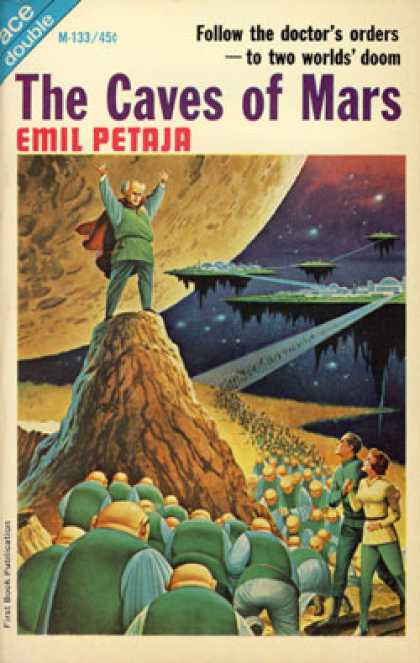
1960s Ace double novel: The Caves of Mars by Emil Petaja

The Caves of Mars (1965), a novel by Emil Petaja

At left: Paperback original (New York: Ace Books, 1965), 125 p., #M-133, 45¢. Cover by artist Alex Schomburg. An Ace double novel, bound with Space Mercenaries by A. Bertram Chandler.

Here is the blurb from inside the front cover:

Ric Coltor had lost an arm in an interplanetary exploration. For a spaceman at any other time, that would have meant the end of his career. But not with the marvelous Martian Panacea in existence. Extracted from a fungus found only on the Red Planet, it promised mankind perfect health and longer life, for it grew back internal organs, conquered disease, and could even grow back arms. ...
gave its users glowing good health, but it also gave them a fanatical devotion to the man who administered it, Dr. Morton Krill. A devotion that was so all-encompassing that any man who received it could easily become dictator of two planets if he were twisted enough to desire that. Dr. Krill was!


In his The Ultimate Guide to Science Fiction (1990), David Pringle called The Caves of Mars “an ill-written, low-pressure space opera.”

Surprisingly, noted SF&F critic Rich Horton has not reviewed Petaja's The Caves of Mars.

Equally surprising: You can read the first 30 pages of The Caves of Mars online!