Earlier in January, Mark Graham of the Rocky Mountain News provided a short review of The Empress of Mars (2008), a new full-length novel by Kage Baker that was recently published by Subterranean Press as a limited edition. Giving the novel a grade of “A,” here’s Graham’s final word: “This is the most enjoyable science fiction novel I've read in a long time." A less-expensive trade edition of The Empress of Mars is scheduled to be published by Tor Books in Spring 2009.
Saturday, January 24, 2009
A short review of Kage Baker’s new novel The Empress of Mars
Earlier in January, Mark Graham of the Rocky Mountain News provided a short review of The Empress of Mars (2008), a new full-length novel by Kage Baker that was recently published by Subterranean Press as a limited edition. Giving the novel a grade of “A,” here’s Graham’s final word: “This is the most enjoyable science fiction novel I've read in a long time." A less-expensive trade edition of The Empress of Mars is scheduled to be published by Tor Books in Spring 2009.


Friday, January 23, 2009
Lake of the Sun, a novel by Wynne Whiteford
 Lake of the Sun (1989), a novel by Wynne Whiteford
At left: Paperback original (New York: Ace Books, 1989), 249 p., $3.50. Cover art by Don Dixon. Here
is the blurb from the back cover of the book:
"When the explosions began, shaking the very roof of his world, only Rah had the courage to climb to the surface to investigate. There he found a strange machine, tended by two-eyed creatures with silvery skin. Aliens! A deep chill touched Rah’s very soul. The unbelievable had finally happened. Mars had been invaded!"
According to Strange Constellations: A History of Australian Science Fiction (1999), by Russell Blackford, Van Ikin and Sean McMullen, Lake of the Sun is “a novel of first contact between Martians and humans, although both of these groups also subdivide, and it turns out they are closely related genetically, sharing a history in the deep past. The Martians, who live deep underground where there is water and breathable air, have a basic industrial technology with spring-driven motors and primitive electrical devices. They fall into the two categories of the Gulf People (or vora) and a smaller number of one-eyed Lake People (or ashti), who were originally outcasts but are now a more biologically evolved and technologically advanced group. Those humans who have become adapted to the low gravity of Mars are spider-like, with seemingly globular bodies (as observed from the viewpoint of Earth visitors) and elongated limbs. The presence of humans on Mars exacerbates difficulties between the Gulf and Lake peoples almost precipitating an arms race and a destructive war between these otherwise peaceful groups. A headstrong young member of the Gulf People, Vordok, emerges as the villain, contemplating a personal empire brought about by violence.”
Wynne Whiteford’s Lake of the Sun won the Ditmar Award in 1990 for Best Australian Long Fiction.
Thursday, January 22, 2009
Three Mars novels make author Don D'Ammassa's list of recommended titles for 2008
 Author, reviewer, and longtime science fiction fan Don D'Ammassa has written an excellent essay titled
“2008: The Year in Science Fiction Literature” in which he recommends reading three of the year’s Mars novels: Mars Life by Ben Bova, Marsbound by Joe Haldeman, and Rolling Thunder by John Varley.
Cheers to John DeNardo of the blog SF Signal for the tip!
Win a Mars book in Sci-Fi photo caption contest
 Gary Robbins, Sciencedude of California’s Orange County Register, is hosting a science fiction photo caption contest. The reader who comes up with the best caption for this photo of a UFO over the White House will win a copy of author Andrew Chaikin’s nonfiction book,
A Passion for Mars: Intrepid Explorers of the Red Planet (2008).
Wednesday, January 21, 2009
Coming Attractions: The Lost Hieroglyph, a film of Brackett & Burroughs adventure
 Thanks to an update from independent filmmaker Steve Weintz of Big Sur, California, you can view
a promotional poster for his forthcoming film,
The Lost Hieroglyph, a retro sci-fi adventure in
the tradition of Brackett and Burroughs.
The Lost Hieroglyph is still in pre-production, but the pilot script
is complete and a five-minute trailer is being prepared. Here's the pitch, which Weintz was gracious enough to share with me last December:
Working Title: The Lost Hieroglyph
Genre: Retro sci-fi adventure
Format: Stop-motion animated miniseries
Premise: An adventurer-writer couple goes to Mars to find a missing brother and a lost book; they foil a plot to destroy the Martians and enslave Earth.
Special: Style is period sci-fi/noir: "2001 as imagined in 1949"; characters are modeled after 1940s-1950s actors; puppets played by contemporary actors are modeled on their likenesses.
Podcast: Author Robert Zubrin on The Space Show
 Dr. Robert Zubrin, noted author, aerospace engineer, and president of The Mars Society, appeared recently as a guest on The Space Show, a California radio program hosted by Dr. David Livingston that focuses on issues influencing the development of outer-space commerce and space tourism.
In a lengthy conversation that lasted nearly 90 minutes and which you can listen to as a podcast, Dr. Zubrin and Dr. Livingston discussed Mars, Methane and life on Mars, human missions to Mars, President Obama's space policy, the Moon vs. Mars, NASA, terraforming Mars, space solar power for Mars, and Dr. Zubrin's new book How to Live on Mars: A Trusty Guidebook to Surviving And Thriving on the Red Planet (2008).
For a detailed summary of the conversation, read Dr. Livingston's notes.
Tuesday, January 20, 2009
Subterranean Press to reprint “The Toad Prince," a Martian fairy tale by Harlan Ellison
 Subterranean Press announced that it will reprint “The Toad Prince or, Sex Queen of the Martian Pleasure-Domes” (2000), a fairy tale by Harlan Ellison, and eight other stories in Son of Retro Pulp Tales, a new anthology edited by Joe R. Lansdale and Keith Lansdale. Continuing in the vein of the award-winning Retro Pulp Tales, the forthcoming Son of Retro Pulp Tales contains “everything from Lovecraftian monsters to demons to hardboiled shootouts to plain ole unchained oddness" and will be published in May 2009.
From books, President Obama found voice
 From Books, New President Found Voice
The New York Times
January 18, 2008
By Michiko Kakutani
WASHINGTON -- In college, as he was getting involved in protests against the apartheid government in South Africa, Barack Obama noticed, he has written, “that people had begun to listen to my opinions.” Words, the young Mr. Obama realized, had the power “to transform”: “with the right words everything could change -- South Africa, the lives of ghetto kids just a few miles away, my own tenuous place in the world.”
Much has been made of Mr. Obama’s eloquence -- his ability to use words in his speeches to persuade and uplift and inspire. But his appreciation of the magic of language and his ardent love of reading have not only endowed him with a rare ability to communicate his ideas to millions of Americans while contextualizing complex ideas about race and religion, they have also shaped his sense of who he is and his apprehension of the world. ...
Read the entire article in The New York Times.
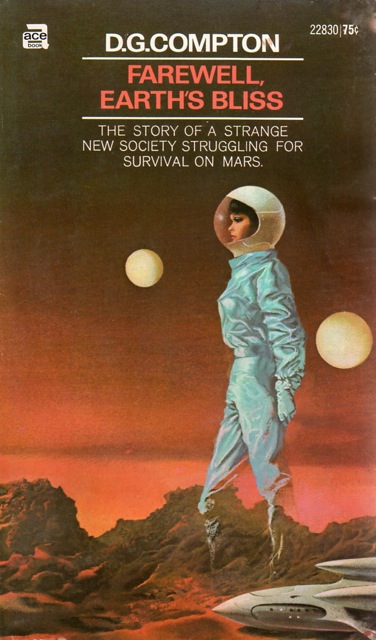
Farewell, Earth’s Bliss, a 1966 novel written by D. G. Compton
 Farewell, Earth’s Bliss (London, 1966), a novel by
D. G. Compton
At left: Paperback (New York: Ace Books, 1971), #22830, 188 p., 75¢. Cover painting by Karel Thole. Here’s the blurb from the back cover of the book:
"The time is the future; space travel has encompassed Mars, finding it barren, without mineral resources, useful only as a dumping ground for socially unacceptable humanity -- a latter-day convict settlement. A new shipload of deportees lands, and the twenty-four new colonists, male and female alike, have to adjust themselves to the harsh life here, and to the unexpected new social patterns that have developed for defense against the hostile Martian environment. Before long, as the colony is shaken by dangers from within and without, the struggle becomes the most basic of all -- not for comfort, but for survival itself."
Two stanzas of a poem, England in Time of Pestilence by Thomas Nashe (1567-1601), are printed on a page inside the front cover. The first line: “Adieu, farewell earth’s bliss.”
Here's what Robert Markley says in his scholarly study Dying Planet: Mars in Science and the Imagination (2005): “In his underrated classic Farewell Earth’s Bliss (1971) the British novelist D. G. Compton depicts the socio-political and psychological effects of the isolation, loneliness, and suffering that the Martian environment represents. Prisoners from Earth exiled to the arid, nearly lifeless planet find themselves confined in an autocratic penal colony. Jacob, a newcomer, lands on Mars and barely survives a dust storm that rages for thirty-seven days and kills many of his fellow prisoners. When the dust clears, he views a landscape that mirrors his psychological state [...] Compton’s description paradoxically pays homage to and rejects romanticized visions of Mars. The harshness of the environment becomes an apt image of both external forms of repression and internalized mechanisms of self-policing. As with oxygen regulators and heat coils, so it is with human will, imagination, and freedom on this Kafkaesque Mars."
Science fiction author, editor, and publisher Donald A. Wollheim owned a copy of Farewell, Earth’s Bliss, according to the Guide to the Donald A. Wollheim Collection at the Kenneth Spencer Research Library, University of Kansas.
Monday, January 19, 2009
Edgar Allan Poe on Mars: The Further Memoirs of Gullivar Jones
 Here’s an interesting science fiction novel that I learned about several months ago: Edgar Allan Poe on Mars: The Further Memoirs of Gullivar Jones (2007) by Randy and Jean-Marc Lofficier. Here’s a description of the novel, taken from website of Black Coat Press, the publisher:
"A legendary warrior from Mars' ancient past. A struggling young writer from 1827 Baltimore. Soon, cosmic events put in motion by the Enchanter Montressor and his ward Ligeia cause the two to meet. Gullivar Jones and Edgar Allan Poe must then learn to work together, if they are to stop the machinations of Rodrik-Usher the Damned ... or both their worlds will be destroyed! An original fantasy in which the famous American writer meets the hero
created by Edwin Arnold in his classic 1905 Martian novel."
According to a posting on the MySpace page of Black Coat Press, Edgar Allan Poe on Mars: The Further Memoirs of Gullivar Jones received a positive review in the December 2008 issue of The New York Review of Science Fiction.
Happy Birthday to Edgar Allan Poe, who was born in Boston in 1809!
And, a belated Happy Birthday to Martin Luther King, Jr., who was born in Atlanta in 1929!
Pictured above: Cover of Edgar Allan Poe on Mars: The Further Memoirs of Gullivar Jones.
An Interview with a Martian coordinator from author Phyllis K. Twombly's universe of blue
 Andrea Smart of the e-zine Smart Interface interviews a Martian coordinator at Scifialiens’s Weblog. It’s part of the fascinating collection of supplemental material Canadian author Phyllis K. Twombly has written to accompany her self-published Martian Symbiont series of science fiction novels. Previous interviews included conversations with Kelly Ravell, a Martian matriarch, Jerod Ravell, her husband, and Dr. Coren Ravell, a chief geneticist.
Twombly’s Martian Symbiont series consists of two novels to date: Been Blued (2007) and Martian Blues (2008). A third novel, which I'm looking forward to reading, is due out in early 2009.
Sunday, January 18, 2009
Book sale: Every Hugo and Nebula Award-winning novel from 1953 to the present!
 Thanks to a fantastic blog post by Capt. Xerox of The Website at the End of the Universe, I learned about a rare and collectable book dealer (David Aronovitz of The Fine Books Company in Michigan) who is offering a complete run of hardcover first editions for every Hugo Award and Nebula Award-winning novel from 1953 to present! The description posted on AbeBooks is a bit sparse (lists authors only) and the asking price is a tad steep ($116,000), but the lot of 126 items presumably includes these treasured works of Martian science fiction:
• Double Star (1956), by Robert A. Heinlein -- Hugo
• Stranger in a Strange Land (1961), by Robert A. Heinlein -- Hugo
• Man Plus (1976), by Frederik Pohl -- Nebula
• Red Mars (1992), by Kim Stanley Robinson -- Nebula
• Green Mars (1993), by Kim Stanley Robinson -- Hugo
• Moving Mars (1993), by Greg Bear -- Nebula
• Blue Mars (1996), by Kim Stanley Robinson -- Hugo
Pictured above: First Edition cover of Heinlein’s Double Star (1956).
New Piece of Flash Fiction: “Sunset on Mars” by Laura Bradford
 The free science fiction story site 365 tomorrows has an excellent piece of flash fiction titled “Sunset on Mars” (2007), by Laura Bradford. It’s about two lovers who are separated by space, time, and a sunset on Mars. Here’s the first line: “He chased her even as her ship touched the stars.”
Paizo Publishing resurrects Otis Adelbert Kline’s The Outlaws of Mars
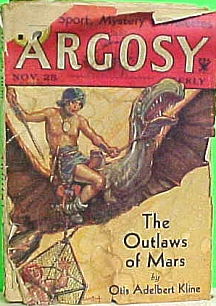
 After painstaking work, the folks at Paizo Publishing have succeeded in resurrecting from the literary graveyard the original, unabridged version of The Outlaws of Mars, a classic sword-and-planet tale by Otis Adelbert Kline that was first published as a seven-part serial in Argosy magazine in 1933 and 1934. According to James Sutter, the editor of Paizo's Planet Stories series, Kline's novel has “sword-swinging adventure on other worlds with strange creatures, bizarre cultures, scantily-clad princesses, and two-fisted plot advancement on every page.” Paizo's reprint of The Outlaws of Mars goes on sale next month, February 2009.
Meanwhile, check out this cool tattered cover of the November 25, 1933, issue of Argosy magazine, pictured above.
Saturday, January 17, 2009
Mars art by SF artist Bob Eggleton
 Bob’s ART du Jour, the blog of award-winning science fiction, fantasy, and horror artist Bob Eggleton, has images of two beautiful 8x10 oil paintings depicting rockets on Mars: “Mars Lift Off” and “Martian Mists.” Both paintings have been sold.
Eggleton is in the process of doing the artwork for two book covers that have Mars as the theme. Meanwhile, check out some of his earlier book covers:
• Labyrinth of Night (1992), by Allen Steele
• Man O’War (1996), by William Shatner
• Rainbow Mars (1999), by Larry Niven
• Martians and Madness: the Complete SF Novels of Fredric Brown (2002), by Fredric Brown, published by the New England Science Fiction Association
• The Martian War: a Thrilling Eyewitness Account of the Recent Invasion as Reported by Mr. H.G. Wells (2005), by Gabriel Mesta
New reference book: Women in Science Fiction and Fantasy
 Liz Henry of Feminist SF – The Blog! has cool photos of an interesting new reference book to which she and Laura Quilter contributed: Women in Science Fiction and Fantasy, edited by Robin Anne Reid (Greenwood Press, December 2008, 2 Vols.). Here’s a description of the work, taken from the website of Greenwood Press:
"Students and general readers love science fiction and fantasy. And science fiction and fantasy works increasingly explore gender issues, feature women as central characters, and are written by women writers. Older works demonstrate attitudes toward women in times past, while more recent works grapple with contemporary social issues. This book helps students use science fiction and fantasy to understand the contributions of women writers, the representation of women in the media, and the experiences of women in society.
The set covers a wide range of media and genres, including fiction, nonfiction, film, television, music, graphic novels, comics, and art. The first volume offers survey essays on topics essential to women in science fiction and fantasy, including: Art and Illustrations, Arthurian Fantasy, Cloning, Fandom, Feminist Spirituality, Gaming, Girls and the Fantastic, Intersections of Class and Gender, Men Writing Women, Science Fiction Novels and Short Fiction, 1900-1960, Sexual Identities, Women's Writing Groups.
The second [volume] offers alphabetically arranged short entries on more specific subjects, such as Amazons, Margaret Atwood, Children's and Young Adult Literature, China, Arthur C. Clarke, Nicola Griffith, Hindu Mythology, Magical Realism, Toni Morrison, Neurodiversity, Quest Fantasy, Utopias, Vampires."
Since Women in Science Fiction and Fantasy is a reference work, it's expensive: $250. Here's the link to Amazon, where you might find pre-owned copies in the near future.
Subscribe to:
Posts (Atom)
67.JPG)

 Posts
Posts